
How Animi uses research
Animi translates research into practical tools for improving alexithymia, noticing and labeling emotions, regulating arousal, processing internal experience, and communicating feelings and needs. The references below are the main sources behind those decisions.
This is a living evidence base rather than a claim that every feature has been independently validated as a standalone intervention. We prioritize validated measures, published intervention research, and techniques with a clear connection to the emotional skills they are intended to support.
Preliminary Animi results
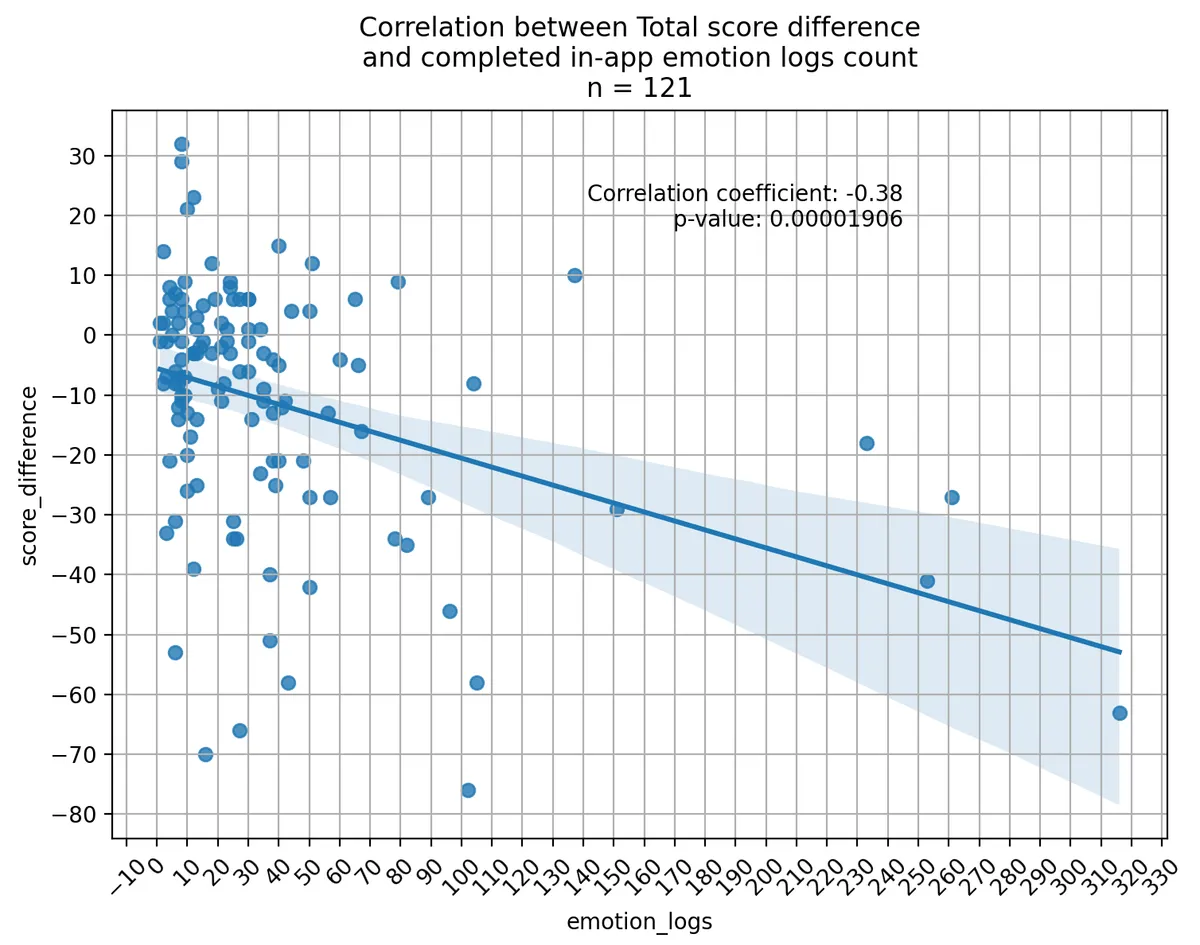
A preliminary analysis of anonymized data from 121 people who completed the Perth Alexithymia Questionnaire at least 30 days apart found a moderate negative correlation between completed in-app emotion logs and change in total PAQ score (r = −0.38, p = 0.000019).
In practical terms, people who logged more emotions tended to show larger reductions in alexithymia scores. This observational result is encouraging, but it does not by itself establish that app use caused the improvement. Controlled prospective research is being planned to test causality and rule out alternative explanations.
121 participants
Each person completed two PAQ assessments at least 30 days apart.
r = −0.38
A moderate association between more emotion logs and greater PAQ score reduction.
p = 0.000019
A statistically strong preliminary signal that warrants more rigorous follow-up research.
Alexithymia measurement and treatment
These sources support how Animi measures alexithymia and structures skill-building for improvement.
Alexithymia interventions
Mazza et al. (2026), “Identifying therapies to effectively reduce alexithymia: A systematic review and meta-analysis.”
PAQ validation
Preece et al. (2018), “The psychometric assessment of alexithymia: Development and validation of the Perth Alexithymia Questionnaire.”
PAQ questionnaire and scoring
Preece et al. (2018), “Perth Alexithymia Questionnaire (PAQ): Copy of questionnaire and scoring instructions.”
Emotion models and vocabulary
Animi’s emotion models and vocabulary tools draw on established ways of organizing affect and expanding emotional language.
Circumplex model of affect
Posner, Russell, and Peterson (2005), “The circumplex model of affect: An integrative approach to affective neuroscience, cognitive development, and psychopathology.”
Plutchik’s psychoevolutionary theory
Plutchik (1980), “Emotion: A Psychoevolutionary Synthesis.”
The Feeling Wheel
Willcox (1982), “The Feeling Wheel: A Tool for Expanding Awareness of Emotions and Increasing Spontaneity and Intimacy.”
Emotional awareness and labeling
These studies inform activities that help people notice emotional experience and translate it into clearer labels.
Emotion Mapping Activity
Edwards et al. (2018), “The Emotion Mapping Activity: Preliminary evaluation of a mindfulness-informed exercise to improve emotion labeling in alexithymic persons.”
Putting feelings into words
Lieberman et al. (2007), “Putting feelings into words: Affect labeling disrupts amygdala activity in response to affective stimuli.”
Emotion regulation and breathing
Animi’s guided regulation exercises use breathing patterns studied for their effects on arousal, mood, and autonomic function.
Upregulation: Bhastrika pranayama
Novaes et al. (2020), “Effects of yoga respiratory practice (Bhastrika pranayama) on anxiety, affect, and brain functional connectivity and activity: A randomized controlled trial.”
Downregulation: cyclic sighing
Balban et al. (2023), “Brief structured respiration practices enhance mood and reduce physiological arousal.”
Regulation: resonance breathing
Chaitanya et al. (2022), “Effect of resonance breathing on heart rate variability and cognitive functions in young adults: A randomised controlled study.”
Emotional processing and communication
These sources inform Animi’s structured approaches to processing internal experience and communicating emotions and needs.
Awareness-of-sensation techniques
Shalev (2019), “Motivated cue integration in alexithymia: Improving interoception and emotion information processing by awareness-of-sensation techniques.”
Core Transformation
Braganza (2019), “Examining the clinical efficacy of Core Transformation: A randomized clinical trial.”
Gendlin’s Focusing and emotional processing
Watson et al. (2006), “Clients’ emotional processing in psychotherapy: A comparison between cognitive-behavioral and process-experiential therapies.”
Nonviolent Communication
Visakavičiūtė and Bandzevičienė (2019), “Impact of the Nonviolent Communication intervention program on the social behavior of the participants: Overview of the systemic research analysis.”
Explore the tools built from this evidence
Take the free PAQ alexithymia test, explore the Emotions 101 course, or read the complete alexithymia guide for more context on the skills and research behind Animi.