
The Short Answer
Alexithymia means having difficulty noticing, identifying and describing your own emotions. In everyday life, that can mean knowing something is off without being able to say what, or working out how you felt only later. The difficulty can get better, at least partly: it tends to be fairly stable over time, but studies have found it can improve with treatment.[1] It is not currently a diagnosis in its own right, and there is no proven cure.[2]
This guide is for people deciding what kind of support to look for. For background on what alexithymia is, see the main alexithymia guide. If you are in danger or thinking about harming yourself, go straight to help right now.
What the Research Shows
How much alexithymia can change
The largest recent 2026 analysis combined results from 47 studies of adults. On average, people who received a psychological intervention, such as a form of talking therapy, arts therapy or structured teaching sessions, ended with lower alexithymia scores than people in the studies’ comparison groups, with moderate effect size.[2]
The studies differed widely in who took part and what was offered, so the average hides a lot of variation. The evidence is mixed on whether a specialist alexithymia program is needed, but whatever kind of support you choose, tell the person helping you about the difficulty so it is not overlooked.
Why no therapy can be called the best
Some suggest that integrative therapy, acceptance and commitment therapy (ACT) or body-based work is the best treatment for alexithymia, and there are a lot of anecdotes online arguing for various approaches that help specific people, but the research does not support a clear ranking so far. In the 2026 analysis, some categories of therapy had larger average results than others, but when the authors tested whether the categories really differed, the differences were too uncertain to conclude that any one type works better.[2]
A 2024 review looked at 18 randomized trials, meaning studies that assign people to groups by chance. About two-thirds of the treatments tested came from the cognitive behavioral therapy (CBT) family, including ACT, and most treatments were followed by lower scores. The authors still judged that the studies were too different from one another to support a standard treatment.[4]
What a lower score does and does not tell you
Most of these studies measure alexithymia with the self-report questionnaires that ask you to rate your own emotional awareness. That can be difficult to judge when emotional awareness is the difficulty, and the 2024 review notes that people with high alexithymia may not rate their own difficulties accurately.[4]
A lower score is a meaningful sign, but it does not guarantee that relationships, work or health will improve. However, one study cited in a mindfulness review found that falling alexithymia scores went along with fewer problems in relationships with other people, so there are some tentative links.[1] For your own purposes, look for changes you can see in daily life as well, as described in reviewing progress together.
How the main options compare
| Option | What the research found | Main limits |
|---|---|---|
| Psychological therapy, across approaches | On average, people who received therapy or structured training ended with lower scores than comparison groups.[2] | Very different studies were combined, the average may be too optimistic, and the search ended in November 2022.[2] |
| CBT-family therapies, including ACT | Most of the treatments in an 18-trial review came from this family, and most were followed by lower scores.[4] | The studies were too varied to combine; all used a self-report questionnaire; a single author selected the studies.[4] |
| Integrative therapies | These combine methods from more than one approach, for example teaching about emotions alongside skills practice and body-based exercises. In the review, they had the largest average drop in scores of any therapy category, slightly ahead of CBT-family therapies.[2] | The categories came from separate studies, not head-to-head trials. The authors’ test could not confirm that any category works better, possibly because there were too few studies to tell.[2] |
| Mindfulness programs | Four randomized trials, taken together, found lower scores than in comparison groups.[1] In a later trial of 285 adults, people practicing either mindfulness or an app-based exercise with a partner, both with weekly coaching, reported fewer difficulties.[5] | Only four trials, and the largest excluded people with high scores.[1] The later trial involved people without clinical-level difficulties, and one author had advised a company developing a related commercial app.[5] |
| Body-based mindfulness program | In a pilot with 73 healthy adults, people who took the program reported lower alexithymia and distress a week after it ended than people on a waiting list.[6] | Groups were not assigned by chance and differed at the start; there was no later follow-up; people with a current mental health condition were excluded.[6] |
| Emotion-recognition app training | In a pilot of 29 people, an information session plus 14 days with an academic demo app improved performance on a computer emotion-recognition task more than the session alone.[7] | Small sample, an untested version of the task, and no follow-up of that main result.[7] |
| Medication | Research has not established a medication for alexithymia itself. In a review of treatment studies, medication was used for diagnosed conditions such as depression.[8] | It may be part of treating a coexisting condition. See where medication fits. |
Consider What May Be Driving It
The same “I don’t know what I feel” can have different backgrounds. For some people it has been there as long as they can remember. For others it began or got worse during depression, burnout, trauma or illness. The main guide explains primary and secondary alexithymia, and the difference affects where it makes sense to start.
When depression, anxiety or trauma is involved
In a study of 46 outpatients with major depression, alexithymia scores fell during 14 weeks of antidepressant treatment, yet the people who scored highest at the start still tended to score highest at the end.[9] Treating depression may ease some of the difficulty without removing it.
A review of 30 studies looked at alexithymia in treatment for conditions such as eating disorders, depression, borderline personality disorder and post-traumatic stress disorder (PTSD). In many of those studies, people with lower alexithymia, or whose alexithymia improved during treatment, did better with the condition being treated. The authors stressed that many findings conflicted and that no specific treatment had been shown to work better for people with high alexithymia.[8]
One study followed 68 people receiving prolonged exposure therapy for PTSD, a treatment in which people gradually revisit traumatic memories and situations they have been avoiding. Those with high alexithymia were more likely to still meet full criteria for PTSD after treatment, although the therapy helped the group as a whole.[10]
If any of these conditions affect your daily life, they deserve assessment and treatment in their own right. Mention the difficulty with naming feelings as well, so it can be part of the plan rather than assumed to resolve by itself.
When the change was sudden or recent
If your ability to read your feelings changed noticeably after a head injury, a neurological illness or a new medication, or alongside changes in memory, speech, sleep or movement, see a doctor first. The US National Institute of Mental Health (NIMH) notes that an examination by a healthcare provider can help rule out a physical cause, because changes such as low mood or trouble concentrating are sometimes due to a medical condition.[11]
Where medication fits
Research has not established a medication for treating alexithymia itself. The review of 30 treatment studies did include medication, but it was used for diagnosed conditions such as depression rather than for alexithymia.[8]
If a clinician diagnoses a condition such as depression, treatment for it may include medication, and alexithymia scores may shift as the condition improves.[9]
Some people taking antidepressants feel emotionally flat. In an online survey of people being treated for depression, almost half reported this kind of emotional blunting, and the authors linked it to depression symptoms as well as to medication.[12] Blunting is not the same as alexithymia, though the two can be hard to tell apart from the inside. If you notice it, tell your prescriber, and talk with them before starting, stopping or changing any medication.
Choosing the Kind of Support
You do not need to choose a specific type of therapy before asking for help. Find the row closest to your situation to see a first step to consider.
| If this sounds like you | A first step to consider | Why |
|---|---|---|
| You feel unsafe, or have thoughts of suicide or self-harm | A crisis line or emergency service now | Safety comes first. See help right now. |
| Low mood, anxiety, an eating disorder, substance use or trauma symptoms are affecting daily life | An assessment with your family doctor or a mental health professional | These conditions need treatment in their own right. Studies of conditions such as depression, eating disorders and PTSD suggest alexithymia can affect how treatment goes.[8] Skill-building can be helpful alongside professional treatment. |
| The change was sudden or recent, or followed an injury, illness or new medication | A doctor’s appointment | A physical cause (neurological, hormonal,…) should be checked first.[11] |
| You are already in therapy but keep freezing at “How do you feel?” | Raising it directly with your current therapist | Sessions can also be adjusted once the difficulty is named. See adjustments to ask for. And building foundational emotional awareness skills can be productive alongside therapy. |
| You are autistic and seeking therapy for anxiety, depression or a similar condition | Asking the service for the adaptations NICE describes | National guidance in England recommends specific adaptations for this group. See what NICE recommends. At the same time, building emotional awareness skills can make a lot of sense. |
| Naming feelings has always been hard, but you are otherwise coping | Optional self-practice, a structured course, therapy, or a mix | Most research tested guided programs and therapy.[2] Trying things on your own is an optional way to explore and prepare. |
Types of therapy you may see listed
- CBT and ACT. In one review of 18 trials, about two-thirds of the treatments tested came from the CBT family, including ACT.[4] Being studied more often does not mean these approaches work better.
- Mindfulness-based programs. These are often taught in groups and train attention to the present moment. A small number of trials found lower scores, as the table above shows.[1]
- Psychodynamic and supportive therapies. These rely more on exploring and expressing feelings in conversation. A research program found alexithymia was linked with poorer outcomes in these therapies.[13] That is a reason to ask how sessions can be adapted, and doesn’t mean they cannot help.
- Integrative therapies. These combine methods from more than one approach. Programs in the 2026 analysis mixed elements such as learning how emotions work, practicing emotional and social skills, group exercises and body-based work. As a group, they had the largest average drop in alexithymia scores of the therapy categories compared, slightly ahead of CBT-family therapies, and the authors suggest that combining approaches may help more than relying on one.[2]
Whatever the label, ask how the therapist works when you cannot find a word for a feeling.
Asking for Therapy That Fits How You Communicate
If “How do you feel?” leaves you stumped, say so in a first call or session. The same research program that linked alexithymia with poorer outcomes in some therapies also found that therapists sometimes reacted negatively to clients with high alexithymia.[13] Neither finding means you are doing therapy wrong. Both are reasons to raise the difficulty early, so that “I don’t know” is treated as information to work with, rather than resistance.
“If I had a dollar for every time a therapist asked me, ‘How did that make you feel?’ and I had no clue at all, I’d be rich enough by now to hire a full-time assistant to express emotions for me.”[28]
YouTube commenter on alexithymia and therapy
What NICE recommends for autistic adults
England’s National Institute for Health and Care Excellence (NICE) has guidance on adapting cognitive and behavioral therapies for autistic adults who also have a common mental health condition, such as anxiety or depression. It says the way these therapies are delivered should include:[14]
- a more concrete and structured approach, with more written and visual material such as worksheets, images and “tool boxes”
- using behavior as the starting point, with more emphasis on changing behavior than on changing thoughts
- making rules explicit and explaining the context for them
- plain English, avoiding excessive metaphor, ambiguity and hypothetical situations
- involving a family member, partner, carer or professional to help put the work into practice, if the person agrees
- giving enough time, regular breaks, and including the person’s special interests where possible
These are not alexithymia-specific adaptations per se, but they are addressing some common issues alexithymics run into as well. If you are autistic, you can point to it when asking a service to adapt therapy for anxiety, depression or a similar condition.
Adjustments anyone can ask for
If you are not autistic, similar adjustments may still make sessions easier, even if they have not been officially tested as a treatment for alexithymia. You might ask:
- “Could we start from a recent situation, or from what I did, rather than from a feeling word?”
- “Could you offer a few possible words, and leave room for none of them to fit?”
- “Can I write things down, use worksheets or bring notes?”
- “Could you say things literally rather than through metaphors, and check that we mean the same thing?”
- “Can we slow down or take a break when I need time to think?”
- “If you ask where I feel something in my body, could you give me an example answer or a few specific things to check?”
When a Therapist Asks Where You Feel It
Some therapists ask a version of “Where do you feel that in your body?” Some people find it a useful way in. Others draw the same blank as with “How do you feel?”, or feel they are being asked to guess an answer the therapist already has in mind.
What the question is usually asking
The therapist is usually asking about physical changes in a particular situation, such as a tight jaw, a racing heart, heat in your face or shaky hands. Together with what was happening and what you did, these changes can be one clue to what you might have been feeling.
The question does not mean that an emotion sits in a particular part of your body. In a Reddit discussion about this question, one person described only recently realizing that their heart racing and hands shaking before a big presentation were their body’s response to nerves. That did not mean the feeling was “in” their heart, but that the heart racing reflected the feeling.[21] The same change can also come with different feelings, or with none: a racing heart can follow excitement, a run for the bus or too much coffee. So it makes sense to read a body change alongside the situation rather than as proof of one particular feeling. Tools that pair sensations with emotions can give you ideas to check, but they cannot tell you what a sensation means for you.
If the question makes no sense to you, you can ask what a typical answer might sound like. One person asked their therapist exactly that, because the question seemed as strange to them as asking what color a cold is.[22] You can also ask for narrower questions, such as “Did your shoulders or jaw feel tight?” or “Did your breathing change?” Another person in the same discussion took a different approach: they talk about whatever they notice and let their therapist sort out what matters, because pre-filtering made their sessions less effective for them.[23]
If you notice little, or can’t tell what it means
Some people notice clear physical changes but cannot tell what they mean. Others notice very little. One person described looking for physical signs of excitement and finding none, only the same calm, flat state they felt in other situations.[24] If that sounds like you, you are not answering wrongly, and you do not need to invent a sensation to give your therapist something to work with. People have different interoceptive baselines - meaning how much they feel emotions and even other general bodily signals in their bodies.
You can start somewhere else instead: what happened, what you did or wanted to do, or what other people noticed. From there you can reason toward a tentative label. One person described inferring their feelings this way, for example deciding that something was wrong and that it was probably frustration, because another person in that situation would be frustrated.[25] A reasoned guess like this is a legitimate way to work out how you feel. You can say how sure you are and change the label later if it stops fitting. Whether a clearer felt sense follows varies between people. The same person said a feelings wheel sometimes helped with the reasoning but had not yet led to really feeling the feeling, though they had only used it for a few months.[25]
Feelings you work out later
Sometimes you only realize how you felt after the session has ended. That realization is still useful. You can write it down when it comes and bring it to the next session, or agree with your therapist to start each session with anything you have worked out since the last one. One person described reflecting in the week between sessions and then bringing it up with something like “I was thinking about what we talked about last session, and it occurred to me…” When they could not name a feeling, they described the physical sensations or the situation instead.[26]
“I can tell that I’m feeling negative emotions or positive emotions. If you give me enough time — measured in days, not minutes or hours — I can maybe identify exactly what that emotion is.”[30]
Reddit commenter in r/AutismTranslated
When a body-first approach doesn’t fit
Starting from the body suits some people and not others. You do not have to produce a sensation, guess the answer you think your therapist expects, or keep turning your attention inward when it makes you more anxious or disconnected. You could say, “Questions about my body leave me guessing. Could we start from what happened, or from what I did?” If focusing inward makes you feel worse, the suggestions under when to pause or adapt a practice apply in sessions too.
“I hated anything that involved paying attention to my body - even just talking about ‘feeling my foot’ could trigger a full on panic attack. If this is you also, just know that you aren’t alone - it’s a common experience for those of us who struggle with alexithymia”[29]
Reddit commenter describing their experience with body-focused attention
Paying close attention to the body can feel uncomfortable at first. If you usually tune out what your body is doing, you may notice tension or other sensations you had not been noticing, and that can be unsettling. In a study that deliberately interviewed meditators who had had difficult experiences, some described heightened body awareness, tension or fear coming up during practice.[31] You do not have to force your way through it. If the discomfort is mild, try a shorter or gentler version. You could keep your eyes open and look around the room, notice what you see on a short walk, or, if it feels comfortable, try some gentle movement. Increase the time or intensity only when it feels manageable. If you experience panic, feel detached or unreal, or the distress persists, stop and talk it through with a qualified professional.
The therapist’s response is important as well. One person said that with several therapists it felt as if the right answer was written on the therapist’s notepad and they had to guess it. They had also felt confused because they see feelings as starting in the mind, with any body tension following, while other people seem to see it the other way round. Working with a therapist who is also autistic has felt very different for them.[27] That is only one person’s experience of fit, not evidence that a therapist’s neurotype predicts how therapy goes all the time, but it does show why it is worth looking for a therapist who treats your way of describing things as valid and is willing to adjust.
Questions to Ask a Therapist
NIMH suggests asking a prospective therapist about their experience, their approach and the evidence behind it, the goals of therapy, how progress will be assessed, what happens if you are not improving, and the limits of confidentiality.[11] Adapted for alexithymia, those questions might be:
- “Have you worked with people who find it hard to identify or describe their feelings?” Listen for specifics rather than a general yes.
- “If I say ‘I don’t know’ when you ask how I feel, what would we do next?” Helpful answers might include offering options, starting from what happened, using written material or giving you time.
- “What approach would you suggest for my goals, and why?”
- “How will we know whether this is helping, and when will we review it?”
- “What happens if it isn’t helping?”
- “If an exercise or question doesn’t work for me, what else could we try?”
- “What are the practical arrangements, costs and limits of confidentiality?”
If you are also being treated for depression, anxiety or trauma, ask how work on emotional awareness would fit into that treatment.
What to bring to a first appointment
Describing your inner world on the spot is often the hard part, so writing things down beforehand can help. You do not need precise emotion words.
- Two or three recent moments when you could not tell what you felt, what happened around them and what you did next.
- Any physical signs you noticed, even without a label for them.
- Things other people have said, such as “you seem distant” or “you never say when something’s wrong.”
- What you would like to be different.
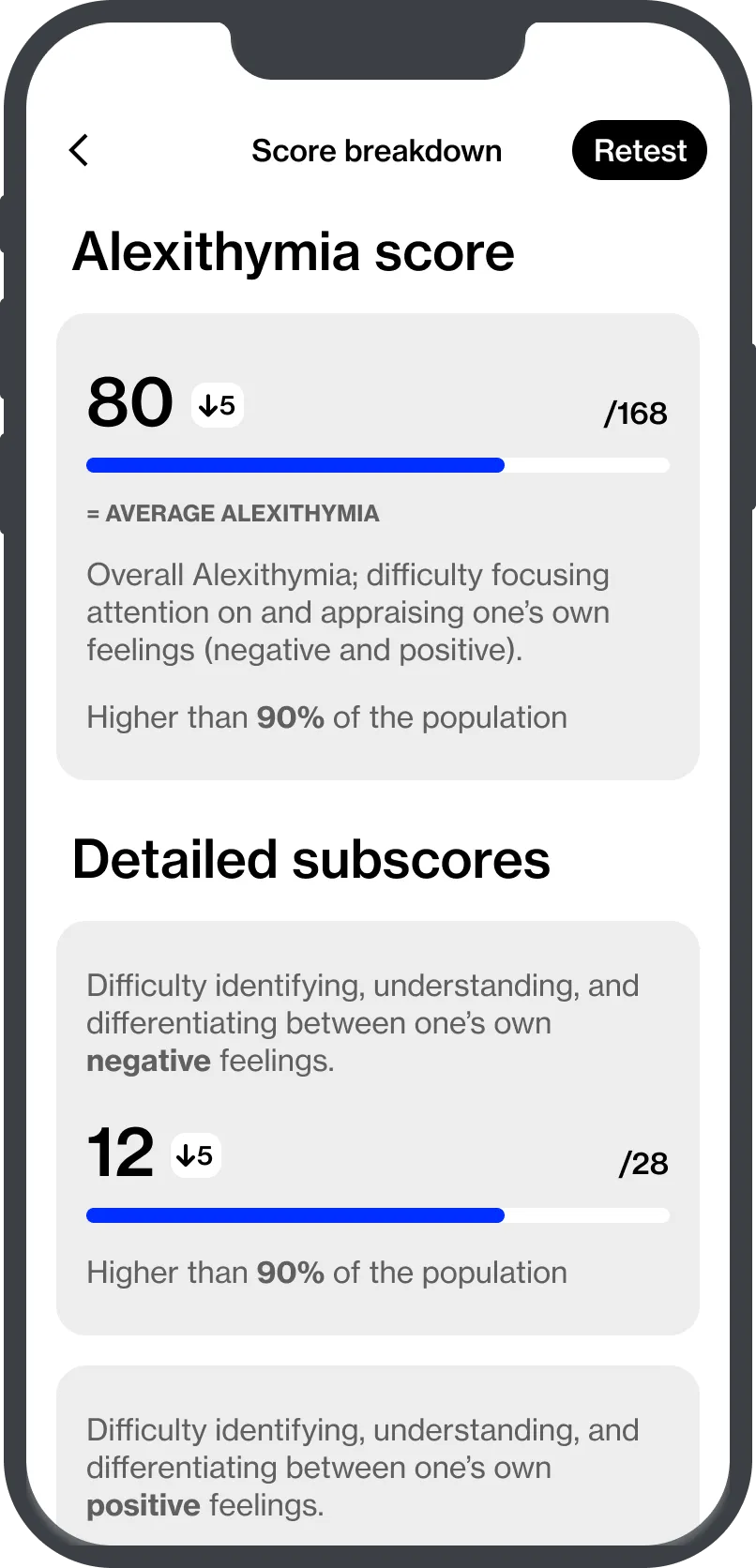
- Your result from the alexithymia test, if you have taken it. It is a self-check rather than a diagnosis, and you can ask for support without one.
Reviewing Progress Together
Agree with your therapist or clinician on a goal you can observe and a date to review it. NICE’s guidance on shared decision making recommends agreeing a plan together and deciding when it will be reviewed. It also says the options discussed should include choosing no treatment, or no change to what you are doing now.[15]
Pick a goal that matters to you. It might be understanding your own feelings better, explaining what you need, noticing overload sooner or finding practical ways to work around the difficulty.
Goals that can be seen in daily life might include:
- noticing that something is wrong sooner, such as the same day rather than days later
- having a few words to choose from instead of only “fine” or “stressed”
- saying “I need time to work this out” during a disagreement instead of going quiet
- recognizing when you need a break
Between sessions, jot down short examples of moments that went differently, or did not. At the review, go through them together: what has helped, what has been hard and any unwanted effects. Then decide whether to continue, adjust the approach or try something else.[11][15] If you retake a questionnaire, discuss the score alongside those everyday examples, because self-report scores have real limits.[4]
Practicing on Your Own
You can use self-practice to explore and learn broader emotional vocabulary, to notice patterns between appointments or to prepare for a first conversation with a professional. It of course has limits - it’s much more difficult to figure out what’s driving your difficulty on your own, and it cannot treat depression or trauma, or respond if you become unsafe.
Research so far says little about practicing entirely alone. Most studies tested therapy, group programs, or training that came with coaching or an information session.[2][5][7]
A check-in you can try
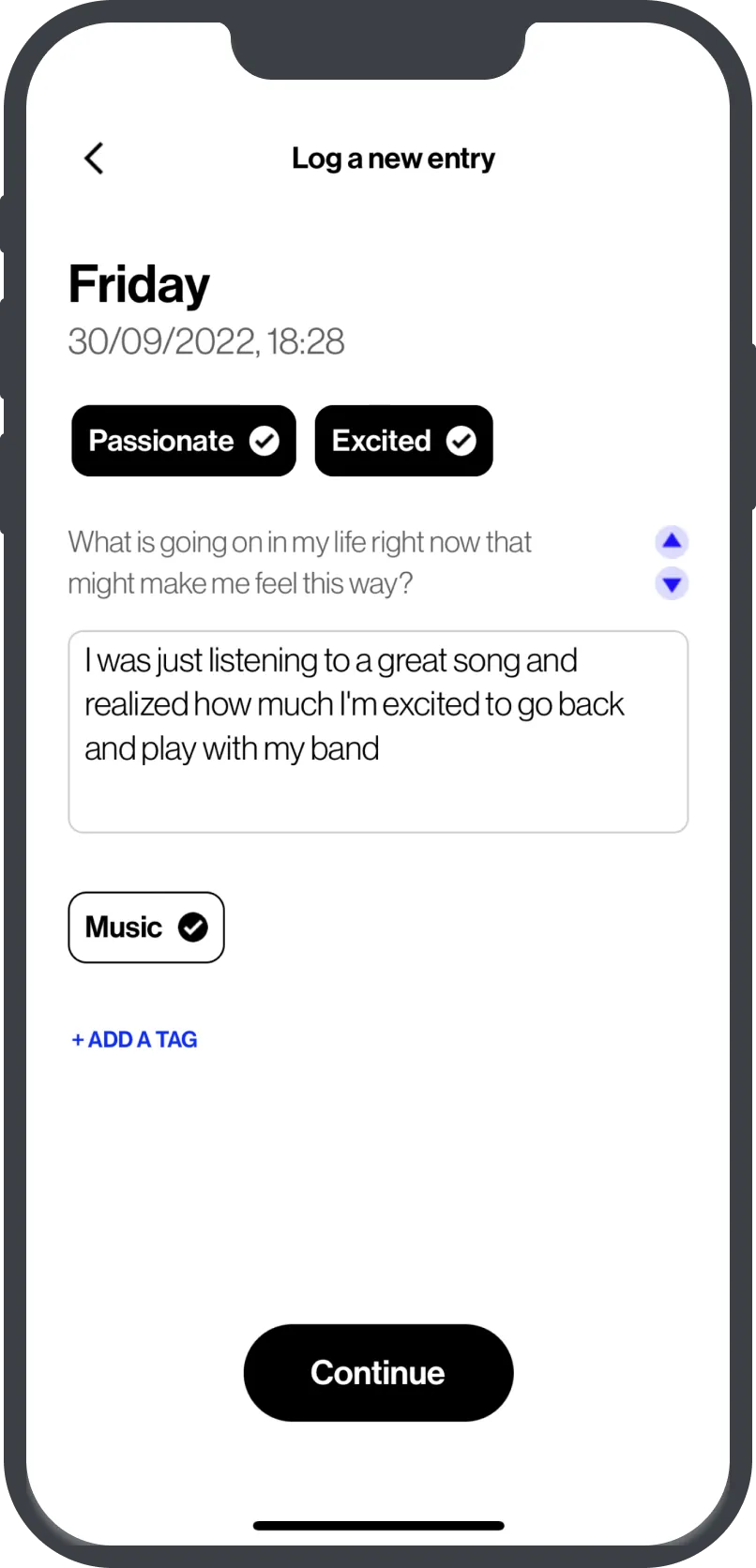
This is a practical suggestion rather than a tested method, and there is no set number of times to do it. When it suits you, for example after something left you unsettled, write down:
- What happened just before.
- What you did next, or wanted to do.
- Anything you noticed in your body, such as tightness, heat or heaviness. Leave this blank if nothing stands out or if focusing there feels uncomfortable.
- Your best guess at a feeling word, picked from a short list if that helps. “Not sure” is a fine answer.
Reading your notes back later can show patterns that are hard to spot in the moment. If you see a professional, you can bring them along.
When to pause or adapt a practice
Close attention to your body or inner state does not suit everyone. A review of 83 meditation studies found that about two-thirds reported at least one unwanted effect in some participants, most often anxiety or low mood, and these sometimes affected people with no previous mental health problems.[16] That review covered meditation in general, not brief check-ins like the one above, so it cannot tell you how risky a particular exercise is.
If focusing inward makes you more distressed, panicky or disconnected, stop, or switch to something that keeps your attention outward, such as writing down only what happened and what you did. Talk with a qualified professional about an approach that suits you better. You do not need to push through a body-focused exercise to work on this or to qualify for help. At the same time, it is often the case that with increased awareness, suppressed issues float to the top first, so it can also be a sign of progress. But this is a difficult topic that requires discernment - please don’t try to white-knuckle through things outside your window of tolerance, and ideally work with a professional.
Apps and structured courses
Apps can add structure, and there is some pilot evidence showing they can be helpful, though the evidence for one app does not mean that another works. One pilot tested a specific emotion-recognition app demo alongside an information session.[7] Another partner-based app in the 285-person trial was used with weekly coaching.[5]
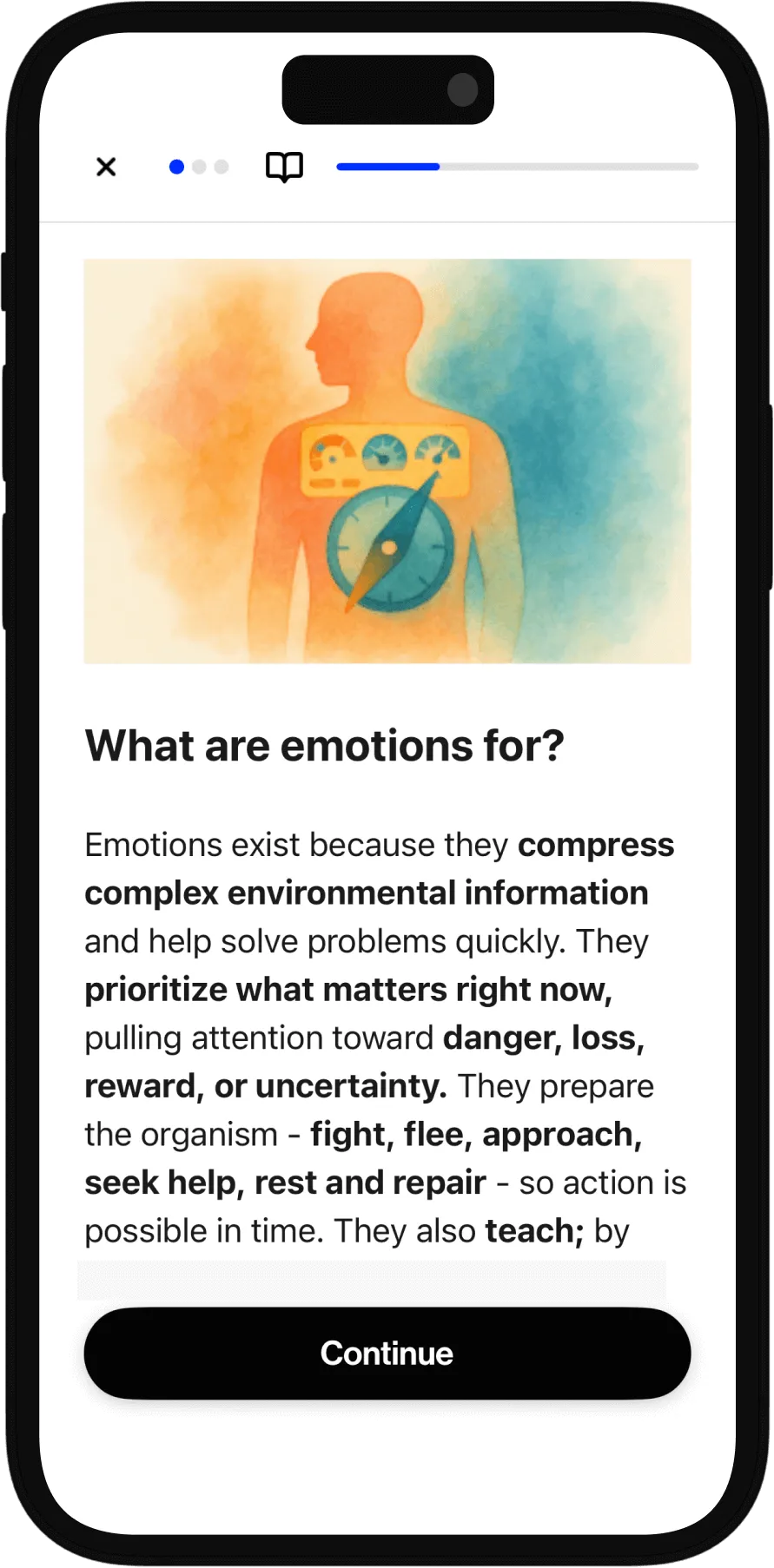
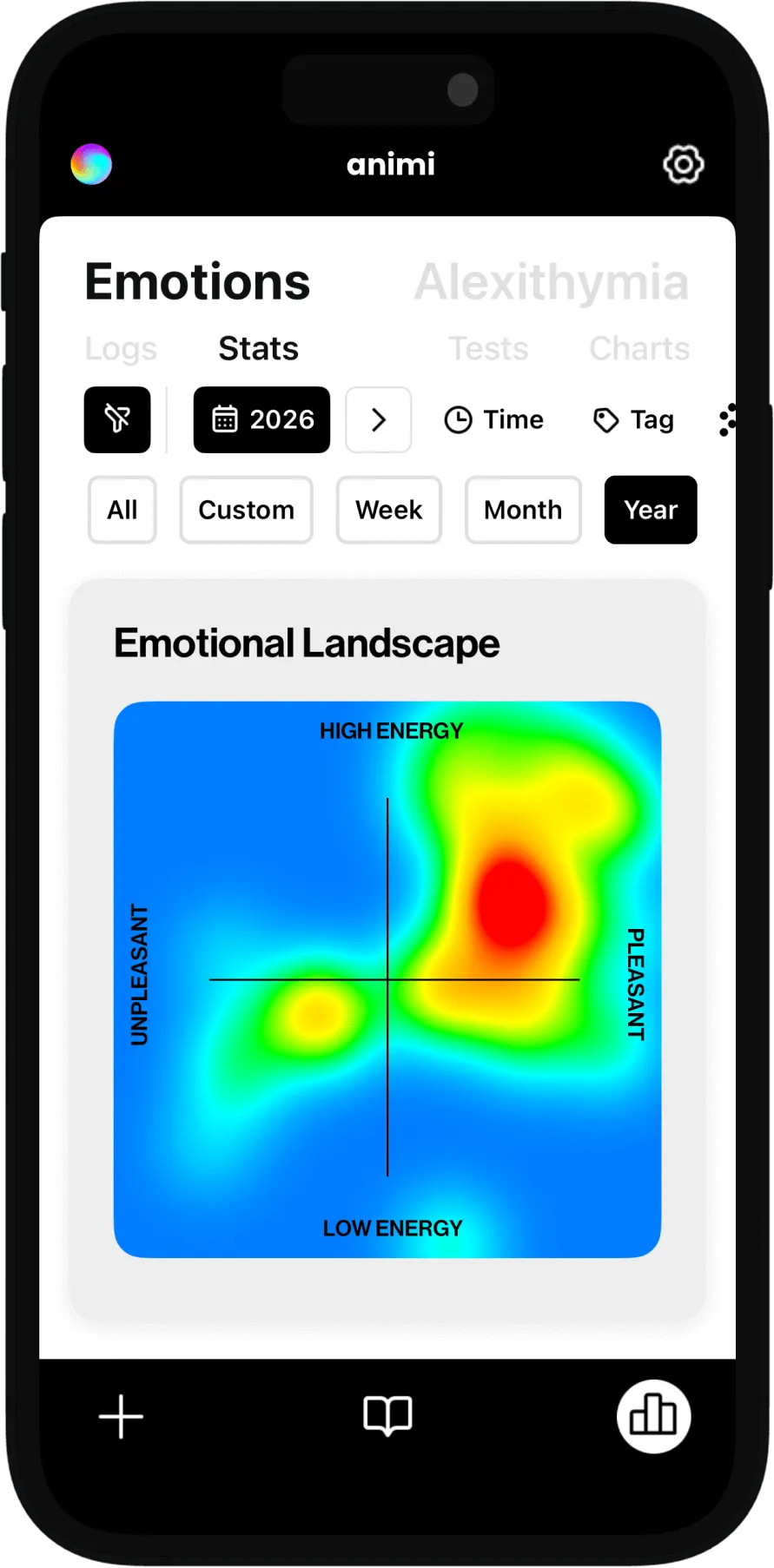
Animi, which publishes this guide, makes an app for logging emotions and a self-guided course, Emotions 101. There is no trial evidence (yet), but an early analysis of Animi’s own user data, described on its evidence page, found that people who logged more emotions tended to show larger drops in alexithymia scores. That was an observational finding, it cannot show that the app caused the change. A controlled study is being prepared.[17] If you try it, treat it as optional practice alongside any assessment or treatment you need.
Finding Support Where You Live
Routes into care differ by country, and service details change, so check the official page before relying on them. In many places a family doctor or GP is a sensible first stop, and you can also contact therapists directly. Check credentials with your local professional register or regulator, and ask about fees and referral requirements up front.
If you need help now
If you are in immediate danger, call your local emergency number. If you are struggling or thinking about suicide, Find A Helpline can help you find a crisis line or support service where you live.[20]
Choose One Next Step
To close it off, you can pick the option that fits your current situation best and start there.
- If distress, safety or daily functioning is the main concern: book an appointment with your family doctor or a mental health professional, and mention that you find it hard to identify and describe feelings.
- If you are autistic and starting therapy for anxiety or depression: ask the service for the adaptations NICE describes.
- If you are already in therapy: send or read out the message above at your next session, and agree a date to review progress.
- If you are mainly curious and otherwise coping: write down one recent example using the check-in, and decide afterward whether you want to talk it through with a professional.
References
Show referencesHide references
- Norman H, Marzano L, Coulson M, Oskis A. Effects of mindfulness-based interventions on alexithymia: a systematic review. Evid Based Ment Health. 2019;22(1):36-43. doi:10.1136/ebmental-2018-300029.
- Mazza A, Davis P, Johnson L, Larkin F, Cole SN. Identifying therapies to effectively reduce alexithymia: A systematic review and meta-analysis. J Affect Disord. 2026;400:121167. doi:10.1016/j.jad.2026.121167.
- Cameron K, Ogrodniczuk J, Hadjipavlou G. Changes in alexithymia following psychological intervention: a review. Harv Rev Psychiatry. 2014;22(3):162-178. doi:10.1097/HRP.0000000000000036.
- Tsubaki K, Shimizu E. Psychological treatments for alexithymia: A systematic review. Behav Sci (Basel). 2024;14(12):1173. doi:10.3390/bs14121173.
- Silveira, Godara, Faschinger, Singer. Reducing alexithymia and increasing interoceptive awareness: A randomized controlled trial comparing mindfulness with dyadic socio-emotional app-based practice. J Affect Disord. 2023. doi:10.1016/j.jad.2023.08.093.
- Quinto, Russo, Scafuto, Innamorati, Montecucco, Ghiroldi. Effects of a body-based mindfulness program on alexithymia, dispositional mindfulness, and distress symptoms: A pilot clinical trial. Behav Sci (Basel). 2025;15(1):55. doi:10.3390/bs15010055.
- Lukas CA, Trevisi Fuentes H, Berking M. Smartphone-based emotion recognition skills training for alexithymia: A randomized controlled pilot study. Internet Interv. 2019;17:100250. doi:10.1016/j.invent.2019.100250.
- Pinna F, Manchia M, Paribello P, Carpiniello B. The impact of alexithymia on treatment response in psychiatric disorders: A systematic review. Front Psychiatry. 2020;11:311. doi:10.3389/fpsyt.2020.00311.
- Luminet O, Bagby RM, Taylor GJ. An evaluation of the absolute and relative stability of alexithymia in patients with major depression. Psychother Psychosom. 2001;70(5):254-260. doi:10.1159/000056263.
- Putica A, Van Dam NT, Felmingham KL, O’Donnell ML. Alexithymia and treatment response for prolonged exposure therapy: An evaluation of outcomes and mechanisms. Psychotherapy (Chic). 2024;61(1):44-54. doi:10.1037/pst0000512.
- National Institute of Mental Health. Psychotherapies. Accessed October 2026.
- Goodwin GM, Price J, De Bodinat C, Laredo J. Emotional blunting with antidepressant treatments: A survey among depressed patients. J Affect Disord. 2017;221:31-35. doi:10.1016/j.jad.2017.05.048.
- Ogrodniczuk JS, Piper WE, Joyce AS. Effect of alexithymia on the process and outcome of psychotherapy: a programmatic review. Psychiatry Res. 2011;190(1):43-48. doi:10.1016/j.psychres.2010.04.026.
- National Institute for Health and Care Excellence. Autism spectrum disorder in adults: diagnosis and management (CG142), recommendation 1.6.3. Accessed November 2026.
- National Institute for Health and Care Excellence. Shared decision making (NG197): recommendations. Accessed October 2026.
- Farias, Maraldi, Wallenkampf, Lucchetti. Adverse events in meditation practices and meditation-based therapies: a systematic review. 2020. doi:10.1111/acps.13225.
- Animi. Animi Evidence Base: Research behind the app. Accessed October 2026.
- NHS. Find an NHS talking therapies service. Accessed November 2026.
- healthdirect Australia. Mental health treatment plan. Accessed November 2026.
- Find A Helpline. Find A Helpline. Accessed November 2026.
- Reddit, r/Alexithymia. Comment in the discussion “Therapist keeps asking ‘where do you feel that in your body’”. Individual experience, October 2026. Accessed November 2026.
- Reddit, r/Alexithymia. Comment in the discussion “Therapist keeps asking ‘where do you feel that in your body’”. Individual experience, October 2026. Accessed November 2026.
- Reddit, r/Alexithymia. Comment in the discussion “Therapist keeps asking ‘where do you feel that in your body’”. Individual experience, October 2026. Accessed November 2026.
- Reddit, r/Alexithymia. Comment in the discussion “Is ‘Alexithymia’ something you can ‘overcome’ or do you just have to work around it?”. Individual experience, September 2024. Accessed November 2026.
- Reddit, r/Alexithymia. Comment in the discussion “Therapist keeps asking ‘where do you feel that in your body’”. Individual experience, October 2026. Accessed November 2026.
- Reddit, r/Alexithymia. Comment in the discussion “alexithymia and therapy”. Individual experience, December 2025. Accessed November 2026.
- Reddit, r/Alexithymia. Comment in the discussion “Therapist keeps asking ‘where do you feel that in your body’”. Individual experience, October 2026. Accessed November 2026.
- YouTube. Comment on alexithymia and therapy. Individual experience. Quotation and source reused from the main alexithymia guide.
- Reddit, r/Alexithymia. Comment in “How do I work on repairing this?”. Individual experience, December 2021. Retrieved November 2026.
- Reddit. Comment on identifying feelings later. Individual experience. Retrieved November 2026.
- Lindahl JR, Fisher NE, Cooper DJ, Rosen RK, Britton WB. The varieties of contemplative experience: A mixed-methods study of meditation-related challenges in Western Buddhists. PLoS One. 2017;12(5):e0176239. doi:10.1371/journal.pone.0176239.