
Free alexithymia test: take the online PAQ questionnaire
This free online alexithymia test uses the Perth Alexithymia Questionnaire (PAQ), the latest and most accurate 24-item self-report measure designed and scientifically validated to map how difficult it is to identify and describe feelings across both negative and positive emotions. Use this page to take the alexithymia test, understand what it measures, what your score means, what you can do about it, and also how PAQ compares to TAS-20, BVAQ, and OAQ-G2 tests.
Quick summary
This test measures alexithymia, the difficulty of identifying and describing emotions. In simple terms: how hard it is noticing how you are feeling, labeling the emotion, describing it to somebody else, and staying in touch with emotions instead of focusing only on facts and always jumping into problem-solving.[1]
If you want the strongest research-backed option for a modern online alexithymia test, the PAQ is the best choice because it provides facet-level detail (subscores), covers both positive and negative emotions, and has better psychometric research validation than the alternatives, while being officially free to use. We also give you a percentile comparison to overall population, and actionable interpretation that actually tells you what the score means and what you can do about it next.[1][2][5]
Historically, TAS-20 has been the most widely used measure, but newer studies have raised caution around its EOT (externally oriented thinking) facet and potential overlap with general distress. BVAQ remains a validated but rarely used multidimensional alternative, while the clinically non-validated OAQ-G2 is now less needed given PAQ can be used freely without permission.[6][7][10][12]
Who this alexithymia test is designed for
This test is for adults and adolescents who want a structured self-check for alexithymia-related difficulties. It can give you a direction to explore if you can often tell that something is happening internally, but the emotion itself is hard to name, describe, or work with.
People who struggle with emotions and are not sure why
Use this test if emotions often feel vague, delayed, muted, confusing, or hard to separate from body sensations, to possibly realize why.
People who want a simple self-check before therapy or self-work
The PAQ can give you language for the pattern, so you can understand what and how to improve, and say more than "I do not know how I feel."
People tracking emotional awareness over time
Because the PAQ gives subscale scores, it is useful to retest over time and see whether specific emotional skills are improving.
PAQ is the only alexithymia test validated for use both in adults and adolescents aged 11 to 18, and in autistic as well as non-autistic samples. That's important because alexithymia is commonly co-occurring with autism, with one meta-analysis estimating it in about 50% of autistic people, and some emotion-processing differences often described as autistic traits may be better explained by alexithymia.[3][4][8]
What this alexithymia test measures
Alexithymia is a transdiagnostic risk factor marked by difficulty identifying feelings, difficulty describing feelings, and a tendency to focus on external facts instead of internal emotional states. The PAQ assesses those patterns across both negative and positive emotions, so the result can show whether the bottleneck is mostly noticing and naming feelings, explaining them, or paying attention to emotions in the first place (or all of them).[1][2]
You know something is happening, but not sure what
Many people with alexithymia can vaguely tell that their body is activated or that something feels off, but they struggle to actually label the emotion.
Describing feelings takes too much effort
It may be hard to find the right words, explain your inner state to another person, or answer questions such as "How do you feel?" without freezing. That is often particularly problematic in therapy and relationships generally.
Emotions stay practical, not experiential
Some people always default to facts, tasks, logic, or problem-solving first and pay less attention to subtle emotional signals until the situation becomes overwhelming.
Important: Alexithymia is not the same thing as autism, depression, or anxiety, though it can overlap with all three and many more. A good screening test should distinguish between "I feel distressed right now" and "I repeatedly have trouble identifying and describing emotions as a trait."
Take the live PAQ questionnaire
Answer all 24 items below to get your overall PAQ score, the five main subscales, and a short interpretation of your alexithymia profile. Read the detailed explanation section below to understand the result actionably.
What your PAQ score is meant to tell you
Higher scores indicate stronger alexithymia-related difficulties, but the practical value is in what you do with the pattern. Use your result as a starting point for deciding what needs most attention.[1]
Difficulty identifying emotions (DIF)
If DIF is high, working on interoception can be useful: learning to notice body signals such as tension, pressure, breath, heartbeat, temperature, and urges, then connecting those signals to words you may be feeling.
Difficulty describing emotions (DDF)
If DDF is high, emotional schema building can be useful: expanding emotional vocabulary, linking sensations and other patterns to situations and needs, and building clearer narratives for what is happening inside in different situations.
Externally oriented thinking (EOT)
If EOT is high, targeting beliefs about emotions can be useful: noticing whether you dismiss or avoid feelings, overvalue rational control, avoid mixed emotions, or learned that emotional attention is unsafe or pointless.
Your PAQ result does not explain why alexithymia is present. Alexithymia can be relatively long-standing (primary) or more situational (secondary or acquired), and it can be shaped by development, upbringing, stress, illness, burnout, trauma, or other life circumstances. If your difficulty with emotions likely stems from a protective shutdown after psychological trauma, the biggest impact may come from processing the trauma itself when ready and with appropriate professional support. Nevertheless, building emotional skills first can also help with that, and make progress in therapy easier.
What to do after you get your result
A useful alexithymia test should not end at a score. The point of testing is to identify the bottleneck, track change over time, and decide what kind of support or training is likely to help.
Look at the pattern, not just the total
If one subscale strongly stands out, that tells you more than a single label ever could. A score concentrated in externally oriented thinking needs a bit different response than a score concentrated in describing feelings. Though scores often cluster and move together.
Build the underlying emotional skills
Alexithymia can usually be improved by addressing unproductive beliefs about emotions, training emotional vocabulary, interoception, and practicing identifying feelings in real time. We've built tools and a course that help you do that in a structured manner.
Retest with the same measure
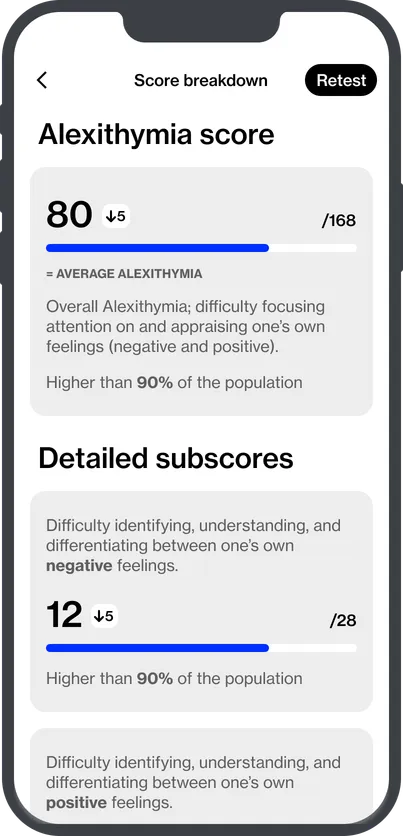
If you want to track progress, repeat the PAQ test over time as you work on yourself. Be patient, as it can take time to see progress, but it is definitely possible. You can also use our app to keep a record of previous tests and see your progress through time visualized.
Common questions about this alexithymia test
Why this alexithymia test is built around the PAQ
The Perth Alexithymia Questionnaire was developed to measure alexithymia in a more detailed way than older tools. In the original validation work, it showed a coherent five-factor structure and good reliability, while later comparison studies found that it captured alexithymia across both negative and positive emotions and provided a more comprehensive facet-level profile than TAS-20. More recent discriminant-validity work also found that PAQ scores loaded cleanly on an alexithymia factor rather than potentially cross-loading onto general distress.[1][2][5]
Measures both negative and positive emotions
Important because some people can track pleasant feelings better than unpleasant ones, or vice versa.
Gives a more useful facet-level profile (subscores)
PAQ separates identifying and describing difficulties across valence domains instead of collapsing everything into one broad number.
Shows stronger recent psychometric support
Recent research has found stronger discriminant validity for the PAQ, while raising concerns about aspects of TAS-20.
There is an additional psychometric reason to be careful with TAS-20. Factor-analytic work has found that what is usually grouped as externally oriented thinking does not always behave like a single clean factor. In one comparison model, it split into "low importance of emotion" and "pragmatic thinking," and those factors did not show acceptable reliability. That does not erase the importance of TAS-20 in the field, but it does explain why many researchers now treat PAQ as the more precise modern option.[7][9]
The five PAQ subscales
The PAQ separates alexithymia into five factor scores, where each factor is measured by a set of questions. That is why the result can be more useful and actionable than a single total number.[1]
- Q2 When I'm feeling bad, I can't tell whether I'm sad, angry, or scared.
- Q8 When I'm feeling bad, I can't make sense of those feelings.
- Q14 When I'm feeling bad, I get confused about what emotion it is.
- Q20 When I'm feeling bad, I'm puzzled by those feelings.
- Q5 When I'm feeling good, I can't tell whether I'm happy, excited, or amused.
- Q11 When I'm feeling good, I can't make sense of those feelings.
- Q17 When I'm feeling good, I get confused about what emotion it is.
- Q23 When I'm feeling good, I'm puzzled by those feelings.
- Q1 When I'm feeling bad (feeling an unpleasant emotion), I can't find the right words to describe those feelings.
- Q7 When I'm feeling bad, I can't talk about those feelings in much depth or detail.
- Q13 When something bad happens, it's hard for me to put into words how I'm feeling.
- Q19 When I'm feeling bad, if I try to describe how I'm feeling I don't know what to say.
- Q4 When I'm feeling good (feeling a pleasant emotion), I can't find the right words to describe those feelings.
- Q10 When I'm feeling good, I can't talk about those feelings in much depth or detail.
- Q16 When something good happens, it's hard for me to put into words how I'm feeling.
- Q22 When I'm feeling good, if I try to describe how I'm feeling I don't know what to say.
- Q3 I tend to ignore how I feel.
- Q6 I prefer to just let my feelings happen in the background, rather than focus on them.
- Q9 I don't pay attention to my emotions.
- Q12 Usually, I try to avoid thinking about what I'm feeling.
- Q15 I prefer to focus on things I can actually see or touch, rather than my emotions.
- Q18 I don't try to be 'in touch' with my emotions.
- Q21 It's not important for me to know what I'm feeling.
- Q24 It's strange for me to think about my emotions.
PAQ vs TAS-20 vs BVAQ vs OAQ-G2
If you want to know whether the result you get is built on a questionnaire that is actually validated and used in research, this is the key comparison.[1][2][10][12]
| Measure | Items | Main dimensions assessed | Published psychometric validation | Breadth of use in peer-reviewed research | Do findings generalize well from the literature? |
|---|---|---|---|---|---|
| PAQ (Perth Alexithymia Questionnaire) | 24 | Difficulty identifying and describing feelings across both negative and positive emotions, plus externally oriented thinking. | Strong. Original development and later comparison studies report coherent factor structure, good reliability, and good discriminant validity. | Growing modern research base, especially when facet-level and valence-specific analysis matters. | Yes, most directly. If you want a test aligned with recent psychometric work, PAQ is currently the cleanest option. |
| TAS-20 (Toronto Alexithymia Scale) | 20 | Difficulties identifying feelings (DIF), difficulties describing feelings (DDF), and externally oriented thinking (EOT). | Historically strong and widely used, but later studies report weaker EOT reliability, reverse-scored item method effects, and potential DIF overlap with general distress. Scale developers themselves advise against deriving or using any facet-level scores. | Historically the most widely used alexithymia questionnaire. | Yes, partly. A lot of research findings used TAS-20 and it still matters, but interpretation benefits from psychometric caution. |
| BVAQ (Bermond-Vorst Alexithymia Questionnaire) | 40 | Emotionalizing, fantasizing, identifying, analyzing, and verbalizing, often summarized into cognitive and affective dimensions. | Meaningful validation history, including reliability and cross-cultural work. It is more established psychometrically than OAQ-G2, though not as commonly used either online or in research now. | Used in research and validation studies in the past, but less dominant than TAS-20 and even less common than PAQ now. | Sometimes. It is a legitimate research instrument, but its structure differs enough from PAQ that direct score comparisons are still not advisable. |
| OAQ-G2 (Online Alexithymia Questionnaire) | 37 | Difficulty identifying and describing feelings, externally oriented thinking, restricted imagination, and interpersonal factors. | No published clinical validation compared to PAQ or TAS-20. Public online background material exists, but psychometric literature using this instrument is non-existent. | Appears online and in some scattered contexts, but it is not used in alexithymia studies at all. | No, not directly. Findings from PAQ- or TAS-20-based studies should not be assumed to transfer to OAQ-G2 results. |
Many websites use OAQ-G2 because it is free for the public. That can make it useful for broad screening, but it is not clinically validated or broadly used in research. The modern peer-reviewed psychometric literature most often relies on validated instruments such as the PAQ, TAS-20, and in some contexts BVAQ, so research findings from those instruments should not be assumed to transfer directly to OAQ-G2-based online tests.[1][2][10][12]
Studies and materials referenced
The claims above are grounded primarily in the psychometric literature on PAQ and TAS-20, with BVAQ and OAQ-G2 included as context because people regularly encounter them when searching for an alexithymia test.
- Preece et al. (2018). The psychometric assessment of alexithymia: Development and validation of the Perth Alexithymia Questionnaire.
- Preece et al. (2020). Assessing alexithymia: Psychometric properties of the Perth Alexithymia Questionnaire and 20-item Toronto Alexithymia Scale in United States adults.
- Trimble et al. (2024). Assessing alexithymia in adolescents: psychometric properties of the Perth Alexithymia Questionnaire in high school students.
- Brett et al. (2025). Characterizing the Nature of Alexithymia in Autistic Adults: Validation of the Perth Alexithymia Questionnaire.
- Preece et al. (2024). Alexithymia or general psychological distress? Discriminant validity of the Toronto Alexithymia Scale and the Perth Alexithymia Questionnaire.
- Preece et al. (2020). Do self-report measures of alexithymia measure alexithymia or general psychological distress? A factor analytic examination across five samples.
- Preece et al. (2018). Assessing Alexithymia: Psychometric Properties and Factorial Invariance of the 20-Item Toronto Alexithymia Scale in Nonclinical and Psychiatric Samples.
- Kinnaird et al. (2019). Investigating alexithymia in autism: A systematic review and meta-analysis.
- Muller et al. (2003). Is there a reliable factorial structure in the 20-item Toronto Alexithymia Scale? A comparison of factor models in clinical and normal adult samples.
- Bermond and Vorst (2001). Validity and reliability of the Bermond-Vorst Alexithymia Questionnaire.
- de Vroege et al. (2018). Psychometric Properties of the Bermond-Vorst Alexithymia Questionnaire in the General Population and a Clinical Population.
- Thompson (2007). Online Alexithymia Questionnaire - G2, Introduction and Factor Targets.
- Williams and Gotham (2021). Improving the measurement of alexithymia in autistic adults: a psychometric investigation of the 20-item Toronto Alexithymia Scale and generation of a general alexithymia factor score using item response theory.
- Preece et al. (2024). Alexithymia profiles and depression, anxiety, and stress.
- Alimoradi et al. (2022). Is alexithymia associated with sleep problems? A systematic review and meta-analysis.
- Mattila et al. (2007). Alexithymia and occupational burnout are strongly associated in working population.
- Mattila et al. (2008). Alexithymia and somatization in general population.
- Zhou, Yang, and Ding (2026). The relationship between alexithymia and loneliness: A meta-analysis.
- Humphreys, Wood, and Parker (2009). Alexithymia and satisfaction in intimate relationships.
- Jang, Goldberg, and Dawson (2025). Alexithymia is associated with greater sexual distress among women and men.
- Shibata et al. (2014). Alexithymia Is Associated with Greater Risk of Chronic Pain and Negative Affect and with Lower Life Satisfaction in a General Population: The Hisayama Study.
- Aaron et al. (2026). Temporal pathways between alexithymia, psychological distress, and pain: An autoregressive mediation analysis.
- Vadini et al. (2024). Alexithymia and estimated 10-year cardiovascular disease risk in healthy adults: a community-based cross-sectional study.
- Terock et al. (2021). Alexithymia is associated with increased all-cause mortality risk in men, but not in women: A 10-year follow-up study.