
What Normative Male Alexithymia Means
Normative male alexithymia is the idea that many men find their feelings hard to put into words because of how they were raised as boys, not because something is wrong with them. The psychologist Ronald Levant proposed it in the early 1990s after working with fathers in a parenting course. He noticed that many of them struggled to name what they felt, though they did not show the more severe difficulties seen in clinical alexithymia.[1]
His explanation was socialization. Levant and his colleagues describe how boys are often “discouraged from expressing and talking about their vulnerable and attachment emotions, and hence do not develop a vocabulary for, or awareness of, many of their emotions.”[1] So “normative” here means common under a social norm. It doesn’t mean normal, healthy, or built in. And because it was learned, it can be practiced in the other direction too.
The lessons behind it are usually small and repeated. A boy who cries hears “toughen up,” or gets laughed at by friends, and learns that showing hurt isn’t safe. Parents report teaching sons more emotional control than daughters, and boys report that they’re expected to hold back their feelings more than girls are.[6] Over time, Levant’s group argues, men end up with the fewest words for two kinds of feelings. The first is vulnerable feelings, such as fear and sadness, that might make them look “weak.” The second is attachment feelings, such as affection and fondness, that might make them look “needy.”[7]
In everyday life, it can look like this:
- Answering “How do you feel?” with “fine,” “stressed,” or a description of what happened.
- Noticing a feeling only once it has turned into irritation, a snap, or tension in the body.
- Reaching for a fix, a task, or a drink when someone else would reach for a conversation.
- Feeling uneasy when a partner wants to talk about feelings or about the relationship.
- Showing care through actions much more easily than through words.
This guide is for men who recognize themselves in that list, and for partners, friends, and parents who want to understand it. It describes a common pattern, not a diagnosis, and plenty of men don’t recognize themselves in it at all.
How Big the Gap Between Men and Women Really Is
A lot of writing on this topic implies that most men simply can’t feel. The research paints a calmer picture. A 2024 meta-analysis pooled 120 studies with 145 samples and 88,721 people, published between 2004 and 2023. It found “a significant and small effect of gender differences in alexithymia.”[2] Men scored a little higher on average, but in 48.2% of the studies women had the higher scores.[2] So most men and most women land in the same range.
The picture gets more interesting when you split alexithymia into its three parts, because the gap runs in different directions.
| Part of alexithymia | Who scored higher on average | Size of the gap | What it means in daily life |
|---|---|---|---|
| Difficulty identifying feelings | Women, in most studies | Small | Men are not, on average, worse at sensing that something is going on inside |
| Difficulty describing feelings | Men | Small | Putting a feeling into words for someone else can be a little harder |
| Externally oriented thinking | Men | Medium, the largest of the three | Attention goes to tasks, facts, and fixing things rather than to inner experience |
The authors note that “A medium and statistically significant effect size was only observed in externally oriented thinking.”[2] That points to a habit of attention more than a missing ability. Many men can feel and sense plenty, but they’ve had years of practice looking outward instead of inward.
Age and culture shape the gap as well. The differences were smallest in adolescence and grew with age,[2] which is what you would expect from a habit that builds up over time. And in countries that score higher on traditional masculine values, the gap between men and women was actually smaller,[2] so the link between culture and the gap is not as simple as “more masculine norms, more male alexithymia.”
Do Men and Women Process Emotions Differently?
Yes, in several measurable ways, so upbringing isn’t the whole story. Men’s and women’s brains respond to emotional cues in somewhat different patterns, hormones tune those responses, and feelings show on the face more or less readily.
| Area | What studies find |
|---|---|
| Showing feelings | While watching emotional films, women were more expressive than men, but the two reported feeling the same amount of emotion. Their skin responses, a measure of body arousal, followed different patterns.[3] |
| Brain response | Across brain imaging studies, women’s amygdala, a key emotion area, responded more strongly to negative images, while men’s responded more strongly to positive ones.[4] |
| Calming down | When both sexes rethought upsetting pictures to feel less bad, they succeeded equally. Men showed less effort in the brain’s planning areas and a bigger drop in amygdala activity, which the researchers think may reflect more automatic regulation.[8] |
| Reading others | Women tend to be better at recognizing emotions in other people’s faces, while men respond more strongly to threatening cues such as aggression.[9][5] |
| Hormones | Oxytocin, testosterone, and progesterone change how the brain responds to emotional faces, especially in the amygdala, and oxytocin’s effects differ between the sexes.[5] |
So the differences are real, but they are differences in pattern, not in the capacity to feel. Men in these studies felt as much emotion as women did, and calmed themselves just as successfully in the lab.[3][8] Reviews of this research describe hormones, genes, brain structure, and environment as working together,[9] so biology can set some starting points while upbringing shapes a lot of what happens next. Normative male alexithymia describes the learned part, and the learned part is what practice can change.
Can’t Notice, Can’t Name, or Not Safe to Say?
When a man says “I don’t know” about how he feels, at least three different things can be going on, and each one calls for a different first step.
| Bottleneck | What it can feel like | A clue | A first move |
|---|---|---|---|
| Can’t notice: the feeling doesn’t register until it’s big | Calm, calm, calm, then a sudden snap or shutdown | You only find out what you felt from your reaction | Short body check-ins during the day |
| Can’t name: you know something is there, but no word comes | ”Off,” “stressed,” or “fine,” with a sense that it’s more than that | Given time and quiet, you still can’t pick a word | Build vocabulary, starting with broad words |
| Not safe to say: you know what you feel, but sharing it seems risky | Choosing silence, a joke, or a change of subject | You can name it privately but not out loud | Practice with one person who has earned it |
The first bottleneck sounds like this post from a man asking other men for advice:
“I feel as though I’m unable to pinpoint my feelings until I have an outburst in either anger or just bursting into any extreme of certain emotions.”[10]
A poster in r/AskMen, asking how other men identify their emotions
The third bottleneck is different, and the research backs it up. When Levant and Parent tested a short scale for normative male alexithymia, it overlapped only moderately with a standard clinical alexithymia scale. It also predicted “restrictive emotionality,” meaning discomfort with expressing vulnerable feelings, even after the clinical scale had been taken into account.[1] So part of what gets called male alexithymia is not about finding the word at all. It’s about whether saying it feels safe. Plenty of men push back on the label for exactly this reason:
“I want y’all to know that men are very aware of what they are feeling or why they are feeling it, no less then women are anyway. They just don’t have the confidence to confide in anyone. Because of either negative responses or no one caring for a long time.”[11]
A commenter in r/PurplePillDebate, replying to a post about normative male alexithymia
”I don’t have trouble expressing my emotions. I have trouble finding ways to express my emotions in ways that are palatable to others.”[12]
A commenter in r/emotionalintelligence, answering why men have trouble expressing emotions
Both can be true for different men, or for the same man at different times. Working out which bottleneck you hit most often tells you where to put your effort.
How Holding Feelings In Affects Men’s Health
Many men learn one main way to handle a strong feeling: keep it from showing. Psychologists call this expressive suppression. In five studies by James Gross and Oliver John, men reported using it more than women in every sample they tested. The two sexes used reappraisal, which means rethinking a situation so it hurts less, about equally.[6]
Suppression works on the outside, because other people see less. But it doesn’t lower the feeling itself. People who habitually suppressed felt more negative emotion and less positive emotion than people who rarely did. They also shared their feelings less, had less emotional support, and reported lower well-being. These links held for men and women alike.[6] So men aren’t worse at handling feelings. More of them have simply been taught to rely on the strategy that costs the most.
Where held-in feelings go
Feelings that are held in still need somewhere to go, and men and women tend to send them in different directions. In a review of emotion regulation and mental health, the psychologist Susan Nolen-Hoeksema found that women report using most regulation strategies more than men do. Women’s greater tendency to ruminate, or go over a problem again and again, partly explains why depression and anxiety are more common in women. And men’s greater tendency to use alcohol to cope partly explains why alcohol problems are more common in men.[13]
The same pattern shows up beyond drinking. Boys and men have higher rates of aggressive behavior and substance use problems, and researchers have proposed difficulty regulating emotions as a common thread linking masculine norms to these problems.[14] A feeling that never gets named or shared can come out in other ways, such as drinking, anger, overwork, or strain on the body.
What it means for mental and physical health
Studies that measure normative male alexithymia directly find a similar chain. A 2025 study of 740 men in the US and UK looked at which masculine norms were linked to depression, anxiety, and stress. Three stood out: emotional control, self-reliance, and putting work first. Each was “significantly and moderately associated with internalizing symptoms via their sequential associations with alexithymia and emotion regulation difficulties.”[15] In plain terms, men who held these norms more strongly tended to have more trouble identifying and describing feelings, then more trouble managing them, and then more distress.
A 2026 study of 325 young men in Pakistan found the same pattern in a very different culture. Men who held more traditional masculine beliefs had more normative male alexithymia, and that in turn was linked to more psychological distress and lower well-being.[16] The authors conclude that although this everyday form is milder than clinical alexithymia, its effect on men’s mental health looks similar.[16]
It can also delay getting help. In a survey of 536 UK men, those with more traditional masculine beliefs, more normative male alexithymia, and more fear of intimacy held more negative attitudes toward seeking psychological help.[17] And the body may pay too. In a nationally representative group of 729 US adults followed for 12 years, people who suppressed their emotions more had a higher risk of dying during that time, and the link was strongest for deaths from cancer.[18]
That chain gives you several places to step in. You don’t have to give up being self-reliant or hard-working. But learning to notice and name what you feel is one of the most direct ways to break the chain, and it’s a skill you can practice on your own.
How It Affects Relationships and Intimacy
Close relationships run on emotional give and take: noticing how your partner feels, letting them see how you feel, and staying close when things get hard. Normative male alexithymia makes each of those harder. In a study of 175 men in relationships, Emily Karakis and Ronald Levant found that men with higher scores feared intimacy more, reported poorer communication with their partners, and were less satisfied with their relationships. The link with fear of intimacy was especially strong.[7] The authors suggest that men who struggle to identify and express their own feelings may also find their partner’s feelings hard to relate to, “and therefore come to fear them.”[7]
Holding feelings in has costs for both people. In Gross and John’s studies, people who habitually suppressed shared fewer of their good and bad feelings, felt more uncomfortable with closeness, and were seen by friends as less close to others.[6] And in lab conversations about an upsetting topic, a person who was asked to hide their feelings disrupted the conversation, built less rapport, and raised blood pressure in both themselves and their partner.[19] The people in those lab studies were women, so the cost seems to come from the strategy itself, whoever uses it.
From the partner’s side, this can feel like living with someone who is there but hard to reach. From his side, it can feel like being asked for something he doesn’t have words for yet. Both are understandable, and both can change. Karakis and Levant point out that these men may simply lack “the necessary emotional vocabulary” for good communication with a partner,[7] and vocabulary is exactly what the practices below are built to grow.
What partners and friends can try
If someone close to you seems shut down, it’s tempting to label it. A label rarely helps the conversation, though. What helps more is making it easier to answer.
- Ask about the body or the situation first. “You seemed tense after that call, what was going on?” is easier to answer than “How do you feel?”
- Offer two options. “Was it more annoying or more worrying?” gives him something to choose from instead of a blank page.
- Leave room for a late answer. Some people only work out what they felt hours or days later. “Tell me later if something comes up” keeps the door open.
- Notice how he shows care. Some men show care mostly through what they do. Naming that you see it can make words feel less risky.
Difficulty naming feelings can explain silence or distance. It never excuses contempt, threats, or violence, and your own safety comes first. The guide to alexithymia in relationships covers how couples can talk about feelings that arrive late.
What Helps, Bottleneck by Bottleneck
A helpful way to think about all of this comes from a discussion among men about alexithymia:
“But I do think it’s more constructive to think of “understanding your emotions” as a mental skill, that needs to be taught and trained like any other. And that (while recognising this might be more difficult for some people) it’s not a binary trait that you either have or not-have.”[20]
A commenter in r/MensLib, in a discussion about alexithymia
The practices below are grouped by bottleneck. Start with the one that sounds most like you. Work within your window of tolerance as you go. Paying more attention to feelings can bring up discomfort you used to tune out, and that can be a sign of progress. If a practice tips you into panic, numbness, or overwhelm, stop, do something that steadies your body, and come back to it more gently later or with support.
Start with the body
If feelings only show up as an outburst, the earlier signals are usually in your body: a tight jaw, a hot face, shallow breathing, or a heavy chest. Pick two or three moments you already have every day, such as your first coffee, getting into the car, or closing the laptop. In each one, take ten seconds to ask, “What is my body doing right now, and how strong is it from 1 to 10?” You don’t need a feeling word yet. Over a few weeks, you start to see which sensations come before the snap, and that gives you a chance to act sooner.
Build words for what you already feel
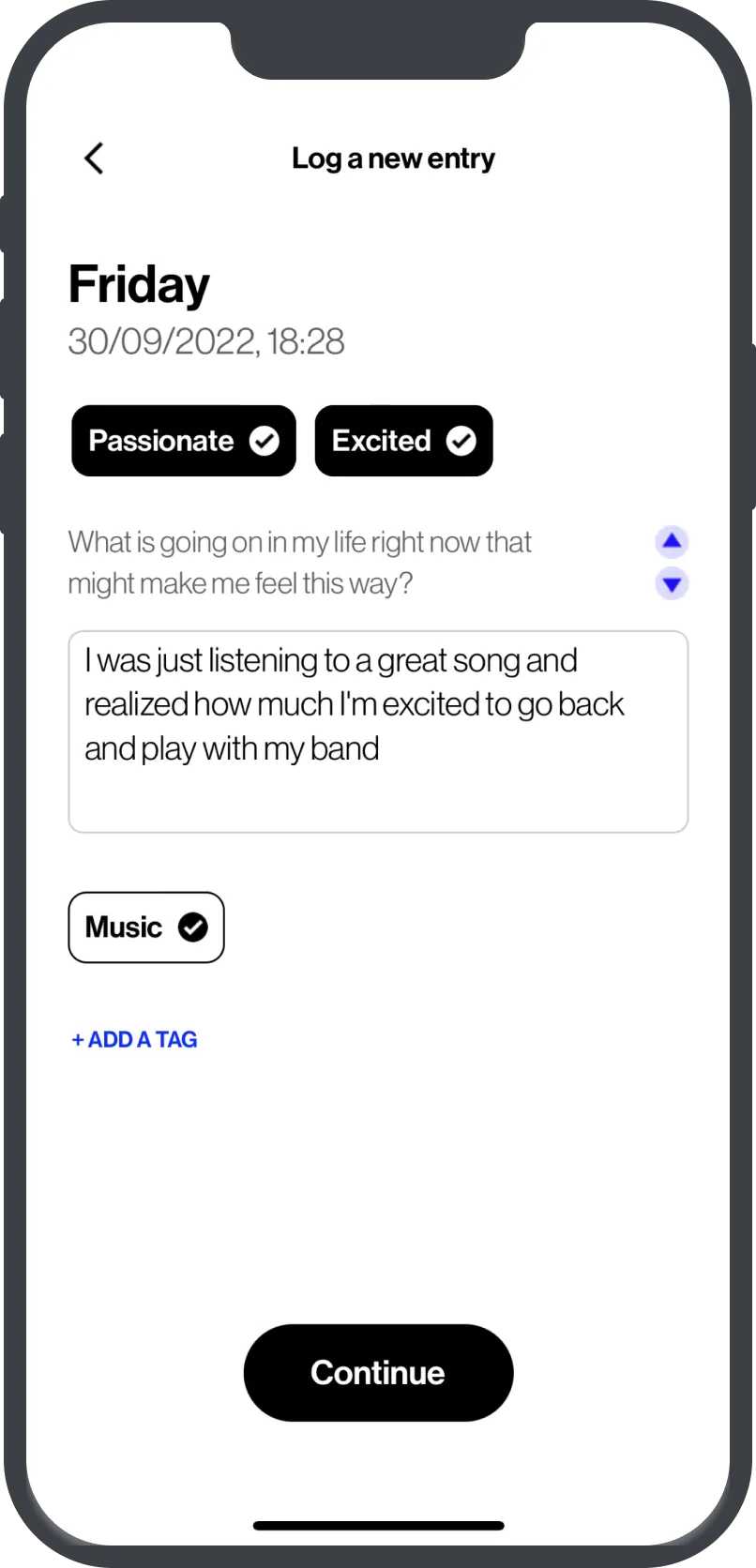
If you can tell something is there but the word won’t come, start rough. “Bad” can become “annoyed,” “let down,” or “worried,” and “fine” can become “relieved” or “flat.” Use the word that comes closest and change it later if a better one turns up. A list or emotion wheel on your phone helps a lot at first, and reading it over a few times a week makes the words come faster. In the meta-analysis above, men on average found describing feelings harder than women did, while identifying them was not harder for men,[2] so words are often where men can make the quickest progress.
Let action come first, then add a label
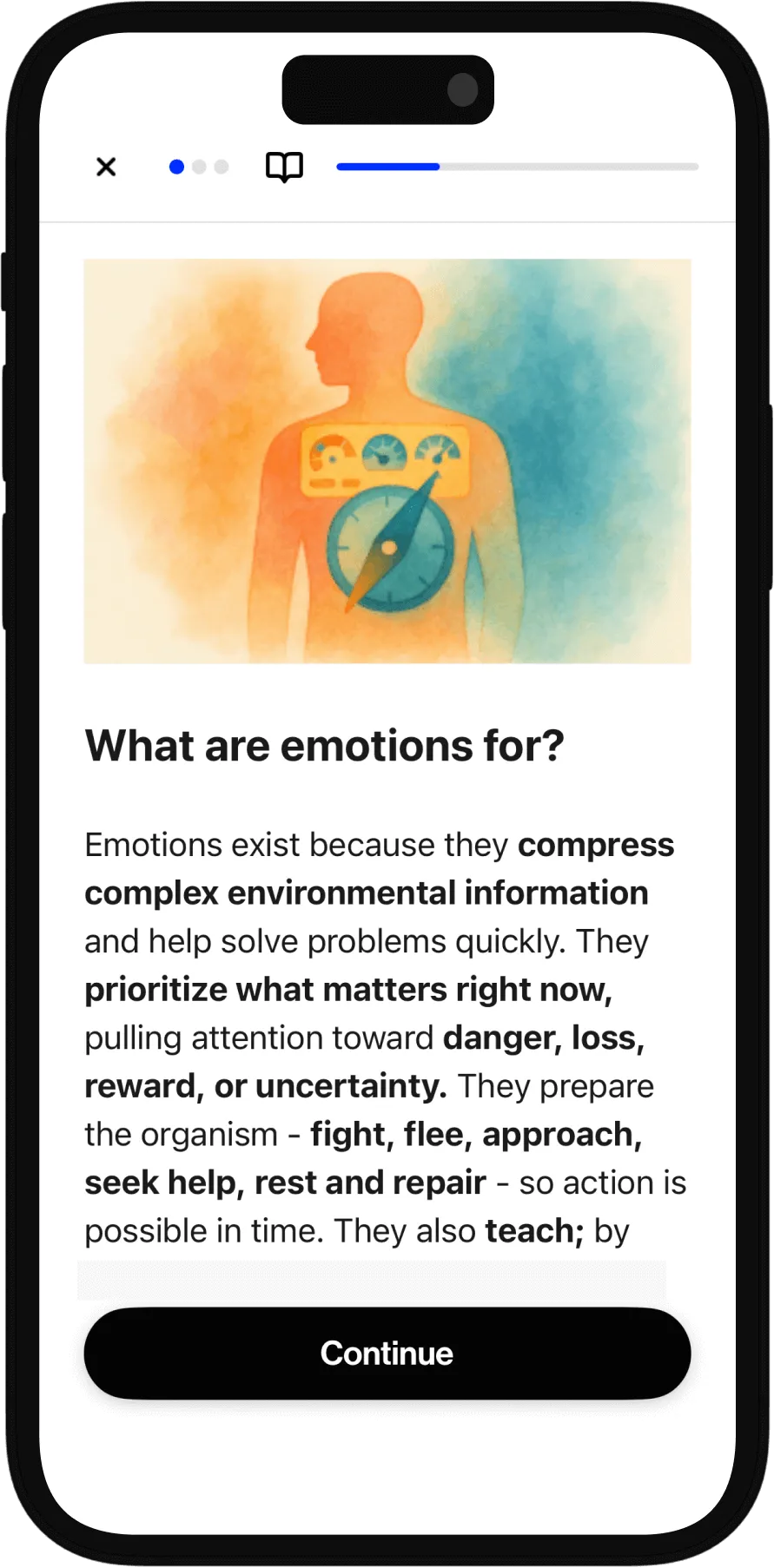
Many men settle strong feelings by doing something: a run, a workout, fixing something, or a long drive. That works, and you don’t need to stop. The step to add is a label afterwards. Once you’ve calmed down, ask what the action was helping you handle. One action deserves a closer look, though: a drink to take the edge off. Using alcohol to cope is the habit most tied to men’s higher rates of drinking problems,[13] so if a drink has become your main way to switch off, try naming the feeling before the drink.
Anger deserves the same treatment, because it often stands in for other feelings.
”My sense is that men aren’t even encouraged to feel anger, just act on it. Really feeling an emotion, the way this video describes, involves sitting with it and noticing what the emotion is trying to do for you; doing that with anger neutralizes the explosive, split-second rage associated with men.”[21]
A commenter in r/MensLib, in a discussion about men and feelings
Next time you feel angry, try asking, “If this anger is protecting something, what is it?” Common answers are hurt, embarrassment, fear of losing something, or feeling ignored. Naming the feeling underneath gives you more options than the anger alone does.
Find one place where saying it is safe
If you already know what you feel but sharing it seems risky, you don’t have to open up to everyone. Choose one person who has shown they can hear hard things without mocking you or using them against you later. That could be a friend, a partner, a sibling, or a therapist. Start small, with something like “I’ve been more stressed about work than I’ve let on.” See how it lands, and build from there. Writing it down first can help as well, since a feeling you’ve already put into words is easier to say out loud. And if no one in your life feels safe yet, a men’s group or a counselor gives you a place to practice.
Next Steps
Pick the bottleneck that sounds most like you and try one practice this week. If feelings tend to arrive as a snap, start with the ten-second body check. If the word won’t come, keep an emotion list on your phone and use it once a day.
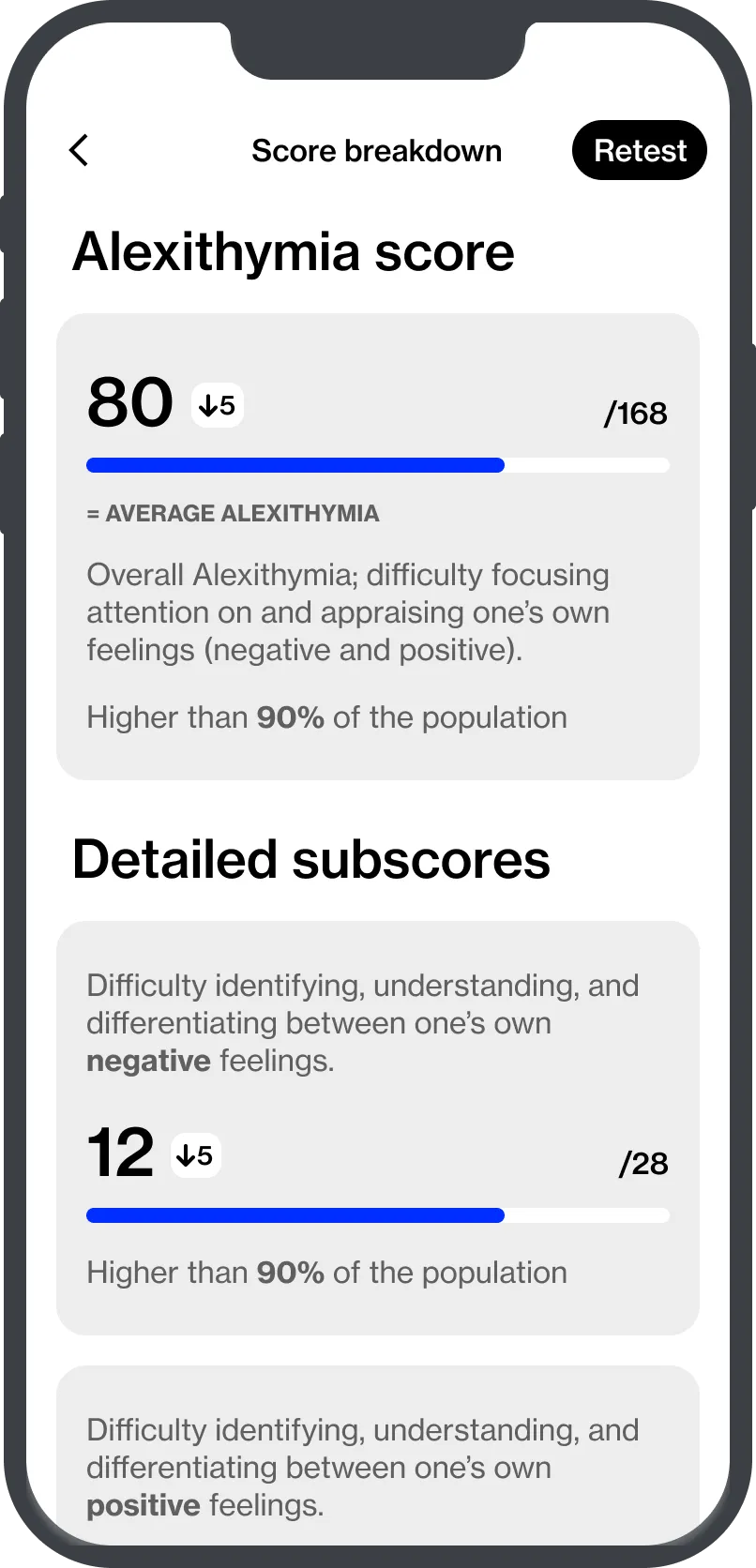
- Take the alexithymia test to get a baseline you can revisit.
- Read the full guide to alexithymia for causes, effects, and how people improve.
- See the guide to alexithymia in relationships if closeness with a partner is where it shows up most.
- See the alexithymia treatment guide if you want to explore therapy or coaching.
- Work through the Emotions 101 course to build body awareness and emotion vocabulary at your own pace.
References
Show referencesHide references
- Levant RF, Parent MC. The development and evaluation of a brief form of the Normative Male Alexithymia Scale (NMAS-BF). J Couns Psychol. 2019;66(2):224-233. doi:10.1037/cou0000312.
- Mendia J, Zumeta LN, Cusi O, et al. Gender differences in alexithymia: insights from an updated meta-analysis. Pers Individ Dif. 2024;227:112710. doi:10.1016/j.paid.2024.112710.
- Kring AM, Gordon AH. Sex differences in emotion: expression, experience, and physiology. J Pers Soc Psychol. 1998;74(3):686-703.
- Stevens JS, Hamann S. Sex differences in brain activation to emotional stimuli: a meta-analysis of neuroimaging studies. Neuropsychologia. 2012;50(7):1578-1593. doi:10.1016/j.neuropsychologia.2012.03.011.
- Huc M, Nikolic M, Power L, McQuaid RJ, Jaworska N. Oxytocin, sex hormones and brain activity in facial expression processing: a sex-based systematic review. Neurosci Biobehav Rev. 2026;184:106610. doi:10.1016/j.neubiorev.2026.106610.
- Gross JJ, John OP. Individual differences in two emotion regulation processes: implications for affect, relationships, and well-being. J Pers Soc Psychol. 2003;85(2):348-362. doi:10.1037/0022-3514.85.2.348.
- Karakis EN, Levant RF. Is normative male alexithymia associated with relationship satisfaction, fear of intimacy and communication quality among men in relationships? J Mens Stud. 2012;20(3):179-186. doi:10.3149/jms.2003.179.
- McRae K, Ochsner KN, Mauss IB, Gabrieli JJD, Gross JJ. Gender differences in emotion regulation: an fMRI study of cognitive reappraisal. Group Process Intergroup Relat. 2008;11(2):143-162. doi:10.1177/1368430207088035.
- Kret ME, De Gelder B. A review on sex differences in processing emotional signals. Neuropsychologia. 2012;50(7):1211-1221. doi:10.1016/j.neuropsychologia.2011.12.022.
- Reddit, r/AskMen. Post “Any guys here know how to identify their emotions?”. Individual experience, November 2022.
- Reddit, r/PurplePillDebate. Comment in a discussion about normative male alexithymia. Individual experience, August 2023.
- Reddit, r/emotionalintelligence. Comment in the discussion “Why do men have trouble expressing their emotions”. Individual experience, December 2024.
- Nolen-Hoeksema S. Emotion regulation and psychopathology: the role of gender. Annu Rev Clin Psychol. 2012;8:161-187. doi:10.1146/annurev-clinpsy-032511-143109.
- Berke DS, Reidy D, Zeichner A. Masculinity, emotion regulation, and psychopathology: a critical review and integrated model. Clin Psychol Rev. 2018;66:106-116. doi:10.1016/j.cpr.2018.01.004.
- Mancini VO, Ditzer J, Brett JD, Gross JJ, Preece DA, et al. Internalizing symptoms in men: the role of masculine norms, alexithymia, and emotion regulation. Sex Roles. 2025;91:71. doi:10.1007/s11199-025-01615-0.
- Liaqat H, Dawood S, Rehman N. Masculinity and mental health: the mediating role of normative male alexithymia. Innov Clin Neurosci. 2026;23(7-9):27-31.
- Sullivan L, Camic PM, Brown JS. Masculinity, alexithymia, and fear of intimacy as predictors of UK men’s attitudes towards seeking professional psychological help. Br J Health Psychol. 2015;20(1):194-211. doi:10.1111/bjhp.12089.
- Chapman BP, Fiscella K, Kawachi I, Duberstein P, Muennig P. Emotion suppression and mortality risk over a 12-year follow-up. J Psychosom Res. 2013;75(4):381-385. doi:10.1016/j.jpsychores.2013.07.014.
- Butler EA, Egloff B, Wilhelm FH, Smith NC, Erickson EA, Gross JJ. The social consequences of expressive suppression. Emotion. 2003;3(1):48-67.
- Reddit, r/MensLib. Comment in the discussion “Alexithymia, and spreading awareness.”. Individual experience, August 2024.
- Reddit, r/MensLib. Comment in the discussion “Therapist explains why you don’t feel anything (alexithymia)”. Individual experience, November 2022.