
Some people with an eating disorder can say exactly what they feel and still struggle with food. Many others can’t. They notice a restless, heavy, or uncomfortable state, and eating, not eating, or another food routine is what makes it go away. Alexithymia, which means having trouble identifying and describing your own feelings, is consistently higher in people with eating disorders than in people without them.[1] This guide explains how the two connect, why hunger and feelings can blur together, and how you can start naming feelings in a way that supports recovery.
How Alexithymia and Eating Disorders Are Connected
Alexithymia is a trait and transdiagnostic risk factor that ranges from mild to strong, and it shows up in three ways: difficulty identifying feelings, difficulty describing them, and a habit of focusing on outside events rather than inner experience. In 2017, Heather Westwood and colleagues at King’s College London pulled together 48 studies that compared people with eating disorders to people without. Every group they looked at, including anorexia, bulimia, and binge eating disorder, scored higher on alexithymia, and the differences were medium to large.[1]
The clearest gap was in identifying and labelling emotions.[1] Describing feelings to someone else came next. So for many people with an eating disorder, the hardest step comes before any talking at all: working out what the feeling is in the first place.
When food becomes the answer to every feeling
A review by Matilda Nowakowski and colleagues describes a common idea in eating disorder research. If feelings seem frightening or unacceptable, restricting food, bingeing, or purging can become a way to avoid them or cope with them.[2] The NHS puts it in plain terms: an eating disorder is a mental health condition where you use the control of food to cope with feelings and other situations.[4]
When you can’t tell one feeling from another, you can’t pick a response that suits it. Sadness, anger, boredom, and even excitement all arrive as one unsorted state, and food is the response that is always within reach. One person, who had moved between comfort eating, anorexia, and binge eating over the years, put it simply:
“I eat if I am stressed especially, but also if sad or anxious or angry. Any emotion really, even good ones.”[5]
A commenter in r/CPTSD_NSCommunity, in a discussion about emotional avoidance and binge eating
The link starts young, too. In a study of 200 children and teenagers who did not have an eating disorder, those with more alexithymia reported more emotional eating and more eating when they weren’t hungry.[6]
How family and friendships fit in
Researchers asked teenage girls with and without anorexia about their relationships with parents and friends, how easily they could name feelings, and their eating disorder symptoms. Once the researchers took alexithymia into account, the links between eating disorder symptoms and relationships with either parent were no longer clear. The link with peers was still there, though alexithymia accounted for part of it.[21] It’s a reason to ask about friendships as well as family life when talking about support. Our guide to alexithymia in relationships has examples of how alexithymics can talk about feelings they’re still figuring out.
When Hunger and Feelings Feel the Same
Most advice about emotional eating starts by asking whether you are physically hungry. That assumes hunger is easy to feel. For some people it isn’t:
“I literally ‘forget’ to eat sometimes. It’s… really hard to explain but for me i have no ‘hunger’. I really dont feel anything until my head starts to hurt and then i remember that i missed a meal.”[7]
A commenter in r/AnorexiaNervosa, in a discussion about why anorexia is hard to quit
Hunger, fullness, a racing heart, and a tight chest all reach you through interoception, your sense of what is happening inside your body. Feelings travel the same route. That is why one part of alexithymia is difficulty telling feelings apart from body sensations.[2] A knot in your stomach could be hunger, nerves, or dread, and without a clear read on either side, it is easy to treat one as the other.
Psychologist April Smith, who studies interoception and eating disorders at Auburn University, explains that not noticing hunger can make restriction easier, and not noticing fullness can feed into bingeing. She adds that these senses can work separately, so someone might recognize hunger well and still struggle to recognize emotions.[8] Noticing a body signal and feeling comfortable with it are different, too. In a 2026 study, women with anorexia or bulimia found a heartbeat-counting task more unpleasant than women without an eating or weight disorder did, even though the groups didn’t differ clearly in how accurately they counted.[9]
But reading body signals isn’t the only difficulty researchers have looked at. In an online survey of young adults, trouble managing feelings helped account for the link between alexithymia and binge eating. Self-reported difficulty sensing the body didn’t account for that link in the same study.[22]
Numbing Feelings With Food or Restriction
For some people the point of the eating disorder is that it turns feelings down. One person in recovery from anorexia described how it worked for them:
“EDs are “great” at numbing uncomfortable emotions - at a huge cost to your physical health and social functioning. I probably didn’t even have the energy to have a panic attack back then.”[10]
A commenter in r/AnorexiaNervosa, in a discussion about why anorexia is hard to quit
Bingeing can do something similar from the other direction, by filling the moment so completely that nothing else gets through. Either way, the feelings don’t get a name, so they don’t get dealt with, and the next time they build up, food is still the only tool you have. Another person, writing about using food to cope since childhood, described what that cost them:
“But the downside of my eating pattern was, that I was also never really able to learn how to regulate my emotions in any other way. So I kept on eating well into my teens and my adulthood.”[11]
A person posting in r/CPTSD_NSCommunity, about emotional avoidance and binge eating
There’s a silver lining there. If food became the main way to deal with feelings because no one taught you another, then learning a different way of regulation can be transformative. You can build the skill of noticing and naming feelings gradually, and each feeling you can name gives you one more option besides food. If your eating patterns grew out of a difficult childhood or other trauma, the alexithymia and trauma guide covers that side in more depth.
A Pause Before Deciding
Common advice says to “name what you’re feeling” before you eat. If naming is the hard part, that advice skips a step. So start with the context around the moment instead, which is easier to read than the feeling itself. Treat what follows as practice you can do alongside treatment, and as part of the plan you already have with your care team if you have one.
Check the context first
When an urge to eat, not eat, or do another food routine shows up, take a short pause and ask:
- When did I last eat, and is a meal or snack due soon?
- What happened in the last hour? A hard conversation, a long stretch alone, a message, or a change of plan?
- What is my body doing right now? Tight, buzzing, heavy, empty, hot, or something else?
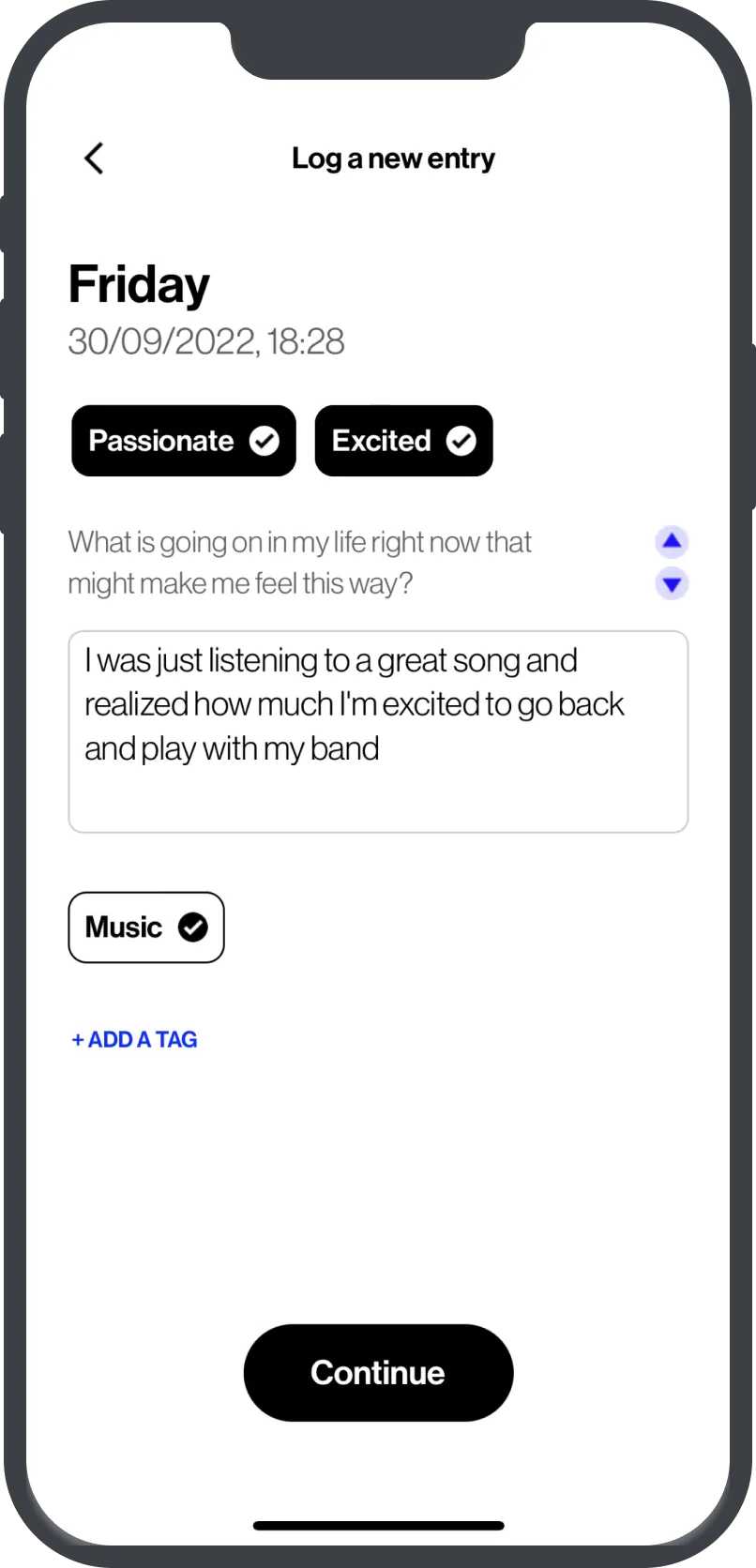
- If I had to pick one rough word for the feeling, what would it be? Upset, tense, flat, or wound up are all fine.
A rough word counts. “Wound up” after an argument is more useful than nothing, and you can refine it later. Writing the answers down helps as well, because a few days of notes can show patterns, such as urges that cluster after certain conversations or times of day, that are hard to spot in the moment. The alexithymia exercises have more ways to build this skill.
Keep checking separate from eating
A pause is for noticing, not for deciding whether you have earned food. If you have a meal plan, eat as planned and check in alongside it. The NHS advises against dieting during treatment for binge eating disorder because it can make bingeing harder to stop.[12] A commenter in another discussion warned about the same trap: deciding you’re “not really hungry” and journaling instead of eating is still restriction.[13]
If you notice yourself using check-ins to delay or skip food, stop the practice and tell someone on your care team. For urges to binge, one commenter described a skill they learned in dialectical behaviour therapy: delaying the urge for ten seconds, then twenty, then a bit longer.[14] A therapist can help you adapt skills like this safely.
Feelings in Eating Disorder Recovery
If an eating disorder kept feelings quiet, recovery can turn the volume back up. One person described what changed as they recovered from anorexia:
“It’s like the world is in color again. I can focus on things other than food or exercise, I’m not territorial over my food because my body and brain knows that there will always be food around. My emotions are a lot more all over the place though. I have higher highs and lower lows, instead of being cold and numb all the time.”[15]
A commenter in r/AnorexiaRecovery, in a discussion about what to expect in recovery
Stronger, messier feelings can be a sign that recovery is working, even when they are uncomfortable. They are also exactly the moments when naming skills help most. Go at a pace you can manage. If feelings become overwhelming, or you start to feel panicky or detached, pause and reach out to your care team or a helpline rather than pushing through alone.
Research shows that emotional awareness can grow, though it doesn’t always happen by itself. Michael Zeiler and colleagues in Vienna followed 91 girls and young women treated for anorexia for a year. Their alexithymia improved, whichever of two therapies they had, and the improvement wasn’t explained by weight restoration alone. The authors recommend that treatment do more to help people identify, tell apart, and describe their emotions.[3] A review of earlier anorexia studies found that alexithymia often stays high even after treatment.[16] Across anorexia, bulimia, and binge eating disorder, though, scores have tended to fall after treatment,[2] and in one study people who had recovered from an eating disorder scored about the same as people who never had one.[1]
Many eating disorder treatments already include this work. The NHS describes cognitive behavioural therapy for anorexia as helping you cope with your feelings, as well as with food.[17] If naming feelings is especially hard for you, tell your therapist. It is useful information, and it can shape how they approach things like feelings wheels or “how did that make you feel?” questions. The alexithymia treatment guide covers the therapies and practices that target emotional awareness directly.
Getting Support
Eating disorders are serious, and most people recover with treatment.[4] If you think you might have one, see your doctor or GP as soon as you can.[4] You don’t need to be able to describe your feelings first. Telling them what you do around food, and how long it has been going on, is enough to start.
- UK: Beat’s helpline is 0808 801 0677.[4]
- US: ANAD’s free eating disorders helpline offers support and referrals at 1-888-375-7767.[18] NEDA’s free, confidential screening tool can help you understand your risk and find resources.[19]
- In a crisis: if you might act on thoughts of harming yourself, call your local emergency number. In the US you can call or text 988, and Find A Helpline lists free support in other countries.[20]
If you have an eating disorder alongside low mood or anxiety, the alexithymia and depression and alexithymia and anxiety guides may help you make sense of those too.
Next Steps
Pick one small step for this week. Try the context check once a day, alongside your usual meals, and write down one rough feeling word each time.
- Take the free alexithymia test to see which parts of emotional awareness are hardest for you.
- Read about interoception and emotions to work with body signals.
- Learn more about alexithymia, its causes, and how it is measured.
References
Show referencesHide references
- Westwood H, Kerr-Gaffney J, Stahl D, Tchanturia K. Alexithymia in eating disorders: Systematic review and meta-analyses of studies using the Toronto Alexithymia Scale. J Psychosom Res. 2017;99:66-81. doi:10.1016/j.jpsychores.2017.06.007.
- Nowakowski ME, McFarlane T, Cassin S. Alexithymia and eating disorders: a critical review of the literature. J Eat Disord. 2013;1:21. doi:10.1186/2050-2974-1-21.
- Zeiler M, Wittek T, Truttmann S, et al. Alexithymia and emotion recognition over the treatment course in adolescents and emerging adults with anorexia nervosa. Eur Eat Disord Rev. 2025;33(6):1265-1275. doi:10.1002/erv.70005.
- NHS. Overview: Eating disorders.
- Reddit, r/CPTSD_NSCommunity. Comment in the discussion “Emotional avoidance and binge eating”. Individual experience, July 2026.
- Shank LM, Tanofsky-Kraff M, Kelly NR, et al. The association between alexithymia and eating behavior in children and adolescents. Appetite. 2019;142:104381. doi:10.1016/j.appet.2019.104381.
- Reddit, r/AnorexiaNervosa. Comment in the discussion “What Made/Makes it so Hard to Quit?”. Individual experience, June 2023.
- Weir K. What is interoception, and how does it affect mental health? 5 questions for April Smith. Monitor on Psychology. 2023;54(3):33.
- Lutz APC, Arend AK, Voderholzer U, et al. Interoceptive profiles of eating and weight disorders. Sci Rep. 2026;16:1045. doi:10.1038/s41598-025-30683-1.
- Reddit, r/AnorexiaNervosa. Comment in the discussion “What Made/Makes it so Hard to Quit?”. Individual experience, June 2023.
- Reddit, r/CPTSD_NSCommunity. Post “Emotional avoidance and binge eating”. Individual experience, July 2026.
- NHS. Treatment: Binge eating disorder.
- Reddit, r/intuitiveeating. Comment in the discussion “Is there a way to distinguish between taste hunger and emotional eating?”. Individual experience, February 2023.
- Reddit, r/CPTSDNextSteps. Comment in the discussion “How to recover from binge eating due to CPTSD?”. Individual experience, February 2021.
- Reddit, r/AnorexiaRecovery. Comment in the discussion “What to expect in recovery?”. Individual experience, January 2021.
- Gramaglia C, Gambaro E, Zeppegno P. Alexithymia and treatment outcome in anorexia nervosa: a scoping review of the literature. Front Psychiatry. 2020;10:991. doi:10.3389/fpsyt.2019.00991.
- NHS. Treatment: Anorexia nervosa.
- ANAD. Eating Disorders Helpline.
- National Eating Disorders Association. Home.
- Find A Helpline. Free, confidential support from a helpline or hotline near you.
- Lukas L, Buhl C, Schulte-Körne G, et al. Family, friends, and feelings: the role of relationships to parents and peers and alexithymia in adolescents with anorexia nervosa. J Eat Disord. 2022;10:143.
- Lyvers M, Kelahroodi M, Udodzik E, Stapleton P, Thorberg FA. Alexithymia and binge eating: Maladaptive emotion regulation strategy or deficient interoception? Appetite. 2022;175:106073.