
Alexithymia and depression often show up together. A review that pooled 35 studies with more than 23,000 people found that the more trouble people have identifying and describing their feelings, the more depressed they tend to be.[1] But the overlap also makes each one harder to spot. Depression can hide behind “I’m fine” when you can’t read your own mood, and a low period can make feelings so flat that alexithymia seems to appear out of nowhere.
How Alexithymia and Depression Are Connected
Alexithymia means having trouble identifying and describing your own feelings. It isn’t a diagnosis or a type of depression, but researchers keep finding it alongside depression. Two large reviews found the same pattern: the link with depression comes mostly from difficulty identifying feelings and difficulty describing them, while a habit of focusing on the outside world rather than inner experience plays a smaller part.[1][6]
They are still two different things. In a survey of 1,888 adults, questions about alexithymia and questions about depression measured separate experiences. But in people who had both, the answers ran together and were much harder to pull apart.[7] That is the situation many readers are in, and it is why the rest of this guide focuses on telling them apart.
Why alexithymia may raise the risk of depression
Researchers widely see alexithymia as a risk factor for depression, and one likely reason is emotion regulation: how you notice, make sense of, and manage what you feel. Knowing which feeling you have gives you a clue about what might help. Sadness after a loss may call for comfort or rest, loneliness for contact, and anger at unfair treatment for speaking up. But when all of these register as the same vague heaviness, it is harder to choose a response that helps, so the feeling can drag on and build up.
David Preece and colleagues tested this idea in an online survey of 501 US adults. People with more alexithymia reported more symptoms of depression, anxiety, and stress, and more difficulty regulating their emotions. When the researchers looked at all three together, alexithymia was linked to symptoms through those regulation difficulties, with no separate direct link.[2] In the same group of adults, people with high alexithymia said they less often rethought a situation, tackled the problem, or asked others for support. They more often hid their feelings, pulled away, or ignored what was going on.[8] Pulling away from friends and activities is also one of the signs of depression the NHS lists, so these habits may be one route from unread feelings to low mood.[5]
A later study by the same team asked 1,250 university students about each part of alexithymia separately, for unpleasant and pleasant feelings. Every part was linked to depression, anxiety, and stress, and the strongest links came from difficulty identifying bad feelings and difficulty identifying good ones.[9] Identifying feelings and choosing how to respond are both skills you can practise, and the steps further down this page start there.
Does alexithymia cause depression?
Being a risk factor doesn’t make alexithymia a proven cause, and the studies that followed people over time point in different directions.[1] In a Finnish study that followed adults for seven years, alexithymia scores didn’t predict who later developed major depression, although they were closely tied to how depressed people felt at the time.[10] In another study, researchers checked pregnant women about once a month. The 16 women who developed depression had the same alexithymia scores as everyone else beforehand. Their scores rose during the depression and fell again after they recovered.[3]
So for many people, depression seems to bring alexithymia with it, at least for a while. Many people with alexithymia also describe the opposite direction. When small feelings go unnoticed, they never get dealt with, and they can pile up:
“you can be depressed you just have a hard time figuring out why because all of the little sads that didn’t draw your attention don’t get processed and add up”[11]
A commenter in r/Alexithymia, in a discussion about whether you can have alexithymia and be depressed
When Alexithymia Lifts as Mood Improves
If you only noticed your trouble with feelings during a low period, there is good news. In a year-long study of 116 outpatients with major depression, alexithymia scores went up and down together with depression scores.[12] In another study, 46 people with depression took antidepressants for 14 weeks, and their alexithymia scores changed significantly as their depression eased. But the people who started with the highest scores still tended to have the highest scores afterwards.[4]
A 2026 study followed 258 outpatients with major depression for six months. At the start, 28% had high alexithymia scores. Among them, about four in ten still did at three months, and about a third at six months. People with and without alexithymia also improved from depression at a similar pace.[13]
Clinicians sometimes describe two kinds of alexithymia. Primary alexithymia is a lifelong, trait-like way of processing emotions. Secondary alexithymia works more like a protective response to illness or strain, and therapists see it as easier to work with.[14] In the general adult population, alexithymia scores stay quite steady over time. In one study of 3,083 Finnish adults, they barely changed across 11 years.[15] Teenagers are different. Their scores shifted more over six years, and rises were linked to earlier symptoms of depression.[16]
So if your trouble naming feelings started or got worse with a low period, there is a good chance it will ease as your mood improves. If it has always been part of you, including in good times, it is more likely a lasting trait. You can build emotional awareness with practice either way.
When Depression Doesn’t Feel Like Sadness
Many people expect depression to feel like deep sadness. But it can show up as flatness, tiredness, or a sense that nothing matters. The NHS notes that depression often comes on gradually, so it can be hard to notice something is wrong, and it can take a friend or family member to point it out.[5] For someone who already finds feelings hard to read, that is even more likely. One commenter described what their worst episodes were like:
“My alexithymic tendencies are exacerbated during severe depressive episodes. The way I would describe it is that I don’t feel anything; the thoughts in my head are very logical, very cold, and very persuasive, and I am listening to the thoughts in my head.”[17]
A commenter in r/Alexithymia, in a discussion about not knowing you have depression
Another person in the same discussion had noticed some signs, such as tiredness and losing interest, but treated them as a small nuisance they could walk off:
“Therapist later pinpointed that i actually had all the symptoms, i just didn’t notice those, which would classify it as severe depression.”[18]
A commenter in r/Alexithymia, in a discussion about not knowing you have depression
Depression can also blur the feelings you do notice. In a study where people recorded their emotions over a week, people with major depression had less distinct negative feelings than people without depression. Sadness, anger, and shame tended to blur into a more general bad feeling.[19] A study of 241 teenagers found the same link between blurred negative feelings and depression.[20] So “I feel bad” or “I feel nothing” may be all you can say during a low period, and that is information too.
When good feelings are hard to read
Alexithymia affects pleasant feelings too. One question researchers use to measure it reads: “When I’m feeling good, I can’t tell whether I’m happy, excited, or amused.”[21] In the student study above, difficulty identifying good feelings was one of the two strongest predictors of depression symptoms.[9] So if good moments only ever register as a vague “fine”, life can seem flatter than it is, and that can look a lot like the loss of enjoyment that comes with depression. Researchers haven’t tested that overlap directly, though.
People also differ in where their difficulties lie. In a Belgian study of 481 adults, some people had trouble with every part of alexithymia, for good and bad feelings alike, while others struggled only with unpleasant feelings. And not everyone with high alexithymia had raised symptoms of depression or anxiety.[21]
To tell the two apart, look at what you do rather than how you would describe it. If you still seek out music, friends, or hobbies and feel drawn back to them, even when you can’t say what they give you, that points toward good feelings you can’t name. If you have stopped wanting them at all, that points toward depression, and it is worth talking to a doctor.
Depression, Alexithymia, or Both?
There is no simple test that separates the two, and many people have both. But a few clues can point one way or the other. Use the table to think through your own situation, and take what you find to a doctor or therapist rather than treating it as a diagnosis.
| Clue | Leans toward alexithymia | Leans toward depression |
|---|---|---|
| When it started | As long as you can remember, including in good times | A change from how you used to be, over weeks or months |
| What happens inside | Feelings happen, and your body reacts, but you can’t name them | Feelings seem flat, muted, or gone |
| Enjoyment | You still enjoy things, even if you can’t describe how they feel | Hobbies, food, or people you liked no longer interest you |
| Sleep, energy, and appetite | Usually unchanged | Sleeping or eating much more or less than usual, or tired all the time |
| Thoughts about yourself and the future | Mostly neutral | Hopeless, guilty, or worthless, or thoughts of death |
| What others notice | You seem calm or hard to read | You seem withdrawn, slower, or not yourself |
The first row is often the most useful. A change from how you used to be points toward depression, as this person, who had been diagnosed with depression, described:
“Even as a teenager I was very emotional. Now I just feel constantly flat. I want to experience those emotions again. I feel dead inside.”[22]
A person posting in r/Alexithymia, asking whether they might have alexithymia
If most of your answers sit in the right-hand column, talk to a doctor about depression whether or not you also have alexithymia. If they sit mostly on the left, you may still want to measure your emotional awareness so you have a starting point.
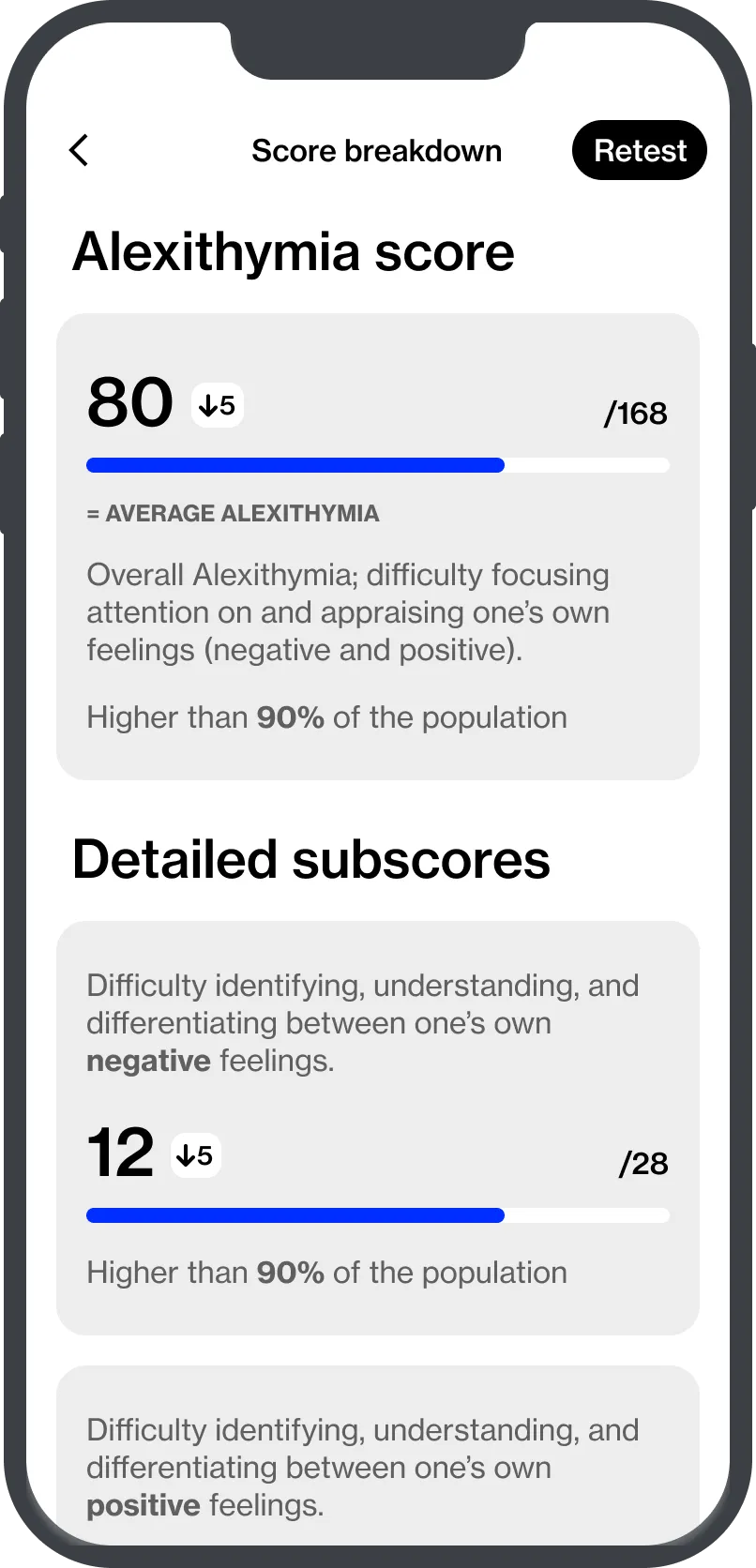
How to Check for Depression Without Relying on Feelings
If you can’t trust your sense of how you feel, look at what you do and what your body does. The NHS lists signs of depression that don’t depend on naming a mood:[5]
- Losing interest in things you used to enjoy, or getting no enjoyment out of life.
- Lack of energy, or moving and speaking more slowly than usual.
- Sleeping badly, for example waking very early, or sleeping much more.
- Changes in appetite or weight.
- Unexplained aches and pains.
- Seeing friends less and neglecting hobbies.
- Finding decisions hard, feeling hopeless, or having thoughts of harming yourself.
One commenter suggested thinking of depression as “objective metrics” rather than feelings, such as changes in eating and sleeping, lost interest, and trouble picturing the future.[17] You can turn that into a simple record. For two weeks, note each day how you slept, whether you ate properly, whether you did anything you usually like, and whether you talked to anyone. Then read the whole two weeks at once. A pattern is often easier to see on paper than from the inside.
It also helps to ask someone you trust. A partner, friend, or family member may have noticed that you seem slower, quieter, or less like yourself. The NHS advises seeing a GP if you have symptoms of depression for most of the day, every day, for more than two weeks.[5] Outside the UK, a family doctor or a licensed therapist is a good first step.
Building Emotional Awareness When Your Mood Is Low
When energy is low, long exercises can feel impossible. Small, regular steps are enough, and they can make it easier to describe what is happening when you talk to someone.
- Name it roughly. “Flat”, “heavy”, or “bad, not sure why” all count. Putting a feeling into words, even a rough one, can calm the brain’s alarm response.[23]
- Ask what kind of bad. Is it closer to tired, sad, lonely, irritated, or empty? Because depression tends to blur unpleasant feelings together, even choosing between two words is useful practice.
- Check your body’s basics. Hunger, poor sleep, and illness can all feel like low mood, so rule them out first.
- Note what came before. Write a line about what happened earlier that day. Over time, you may see which situations bring on your worst days.
Paying closer attention can bring up difficult feelings, and that can be a sign that buried signals are getting through. Keep each practice short and stay within your window of tolerance, the range where you feel some discomfort but still feel in control. If you notice panic, feeling detached or unreal, or distress that doesn’t settle, stop and do something steadying, such as moving, getting outside, or talking to someone you trust.
Getting Help for Depression
Depression is treatable, with or without alexithymia. In the 2026 study of 258 outpatients, people with high alexithymia scores started out more depressed, but their depression improved at much the same pace as everyone else’s. They were more likely to drop out of follow-up, though.[13] So stick with treatment even when it is hard to say whether it is helping, and tell your doctor or therapist if you feel like stopping.
What to tell a therapist
Say early on that you often can’t tell what you feel. That helps a therapist adjust their questions instead of reading “I don’t know” as reluctance. You can ask for:
- A list of feeling words to choose from.
- Ratings instead of words, such as “How low is your mood today, from 0 to 10?”
- Questions about sleep, energy, and what you have been doing, as well as how you feel.
- The chance to bring written notes or your two-week record.
The alexithymia treatment guide covers therapies that work on emotional awareness and how to choose a therapist.
If You Have Thoughts of Suicide
A review of 34 studies found that alexithymia is linked to suicidal thoughts, and less strongly to suicidal behaviour. The authors suggested that suicide prevention should include building emotion regulation skills.[24] With alexithymia, these thoughts may not arrive with distress. The commenter quoted above described them as a calm, persuasive voice rather than an upheaval.[17] Take calm thoughts of death as seriously as thoughts that come with tears.
If you are thinking about ending your life, or you are not sure you can keep yourself safe, get help now:
- Call your local emergency number if you are in immediate danger.
- In the US, call or text 988, the Suicide and Crisis Lifeline.
- In the UK and Ireland, call Samaritans on 116 123, free at any time.
- Elsewhere, use Find A Helpline to reach a crisis line where you live.
Next Steps
Start with the table above, then keep the two-week record of sleep, food, interest, and contact with people. If the record shows a change from how you usually are, book an appointment with a doctor and bring it with you.
- Read the alexithymia guide for the full picture of what alexithymia is.
- Try the alexithymia exercises for step-by-step ways to identify a feeling.
- Read about interoception and emotions to work with body signals.
- If anxiety comes with your low mood, see the alexithymia and anxiety guide.
- If your low mood followed a difficult experience, the trauma and PTSD guide may help.
References
Show referencesHide references
- Liu Z, He S, Hou C. The effect of alexithymia on depression: evidence from meta-analysis. Front Psychol. 2025;16:1465286. doi:10.3389/fpsyg.2025.1465286.
- Preece DA, Mehta A, Becerra R, et al. Why is alexithymia a risk factor for affective disorder symptoms? The role of emotion regulation. J Affect Disord. 2022;296:337-341. doi:10.1016/j.jad.2021.09.085.
- Marchesi C, Bertoni S, Cantoni A, Maggini C. Is alexithymia a personality trait increasing the risk of depression? A prospective study evaluating alexithymia before, during and after a depressive episode. Psychol Med. 2008;38(12):1717-1722. doi:10.1017/S0033291708003073.
- Luminet O, Bagby RM, Taylor GJ. An evaluation of the absolute and relative stability of alexithymia in patients with major depression. Psychother Psychosom. 2001;70(5):254-260. doi:10.1159/000056263.
- NHS. Symptoms: Depression in adults.
- Li S, Zhang B, Guo Y, Zhang J. The association between alexithymia as assessed by the 20-item Toronto Alexithymia Scale and depression: A meta-analysis. Psychiatry Res. 2015;227(1):1-9. doi:10.1016/j.psychres.2015.02.006.
- Hintikka J, Honkalampi K, Lehtonen J, Viinamäki H. Are alexithymia and depression distinct or overlapping constructs?: a study in a general population. Compr Psychiatry. 2001;42(3):234-239. doi:10.1053/comp.2001.23147.
- Preece DA, Mehta A, Petrova K, et al. Alexithymia and emotion regulation. J Affect Disord. 2023;324:232-238. doi:10.1016/j.jad.2022.12.065.
- Preece DA, Mehta A, Petrova K, et al. Alexithymia profiles and depression, anxiety, and stress. J Affect Disord. 2024;357:116-125. doi:10.1016/j.jad.2024.02.071.
- Honkalampi K, Koivumaa-Honkanen H, Lehto SM, et al. Is alexithymia a risk factor for major depression, personality disorder, or alcohol use disorders? A prospective population-based study. J Psychosom Res. 2010;68(3):269-273. doi:10.1016/j.jpsychores.2009.05.010.
- Reddit, r/Alexithymia. Comment in the discussion “Is it possible to have alexithymia and be depressed?”. Individual experience, November 2023.
- Honkalampi K, Hintikka J, Laukkanen E, Lehtonen J, Viinamäki H. Alexithymia and depression: a prospective study of patients with major depressive disorder. Psychosomatics. 2001;42(3):229-234. doi:10.1176/appi.psy.42.3.229.
- Honkalampi K, Savinen S, Ruusunen A, et al. Baseline alexithymia and recovery from major depressive disorder: a longitudinal study. Nord J Psychiatry. 2026. doi:10.1080/08039488.2026.2749588.
- Sagar R, Talwar S, Desai G, Chaturvedi SK. Relationship between alexithymia and depression: A narrative review. Indian J Psychiatry. 2021;63(2):127-133. doi:10.4103/psychiatry.IndianJPsychiatry_738_19.
- Hiirola A, Pirkola S, Karukivi M, et al. An evaluation of the absolute and relative stability of alexithymia over 11 years in a Finnish general population. J Psychosom Res. 2017;95:81-87. doi:10.1016/j.jpsychores.2017.02.007.
- Kekkonen V, Kraav SL, Hintikka J, et al. Stability of alexithymia is low from adolescence to young adulthood, and the consistency of alexithymia is associated with symptoms of depression and dissociation. J Psychosom Res. 2021;150:110629. doi:10.1016/j.jpsychores.2021.110629.
- Reddit, r/Alexithymia. Comment in the discussion “Not knowing you have depression?”. Individual experience, January 2025.
- Reddit, r/Alexithymia. Comment in the discussion “Not knowing you have depression?”. Individual experience, January 2025.
- Demiralp E, Thompson RJ, Mata J, et al. Feeling blue or turquoise? Emotional differentiation in major depressive disorder. Psychol Sci. 2012;23(11):1410-1416. doi:10.1177/0956797612444903.
- DeLap GAL, Vine V, Santee AC, Starr LR. Putting it into words: Emotion vocabulary, emotion differentiation, and depression among adolescents. Emotion. 2025;25(1):102-113. doi:10.1037/emo0001429.
- Fantini-Hauwel C, Gois C, Luminet O, et al. Exploring alexithymia with the French Perth alexithymia questionnaire: latent structure, profiles, and links with affective outcomes. Front Psychol. 2025;16:1615612. doi:10.3389/fpsyg.2025.1615612.
- Reddit, r/Alexithymia. Post “Could I have Alexithymia?”. Individual experience, December 2018.
- Lieberman MD, Eisenberger NI, Crockett MJ, Tom SM, Pfeifer JH, Way BM. Putting feelings into words: affect labeling disrupts amygdala activity in response to affective stimuli. Psychol Sci. 2007;18(5):421-428. doi:10.1111/j.1467-9280.2007.01916.x.
- Hemming L, Taylor P, Haddock G, Shaw J, Pratt D. A systematic review and meta-analysis of the association between alexithymia and suicide ideation and behaviour. J Affect Disord. 2019;254:34-48. doi:10.1016/j.jad.2019.05.013.