
Alexithymia and Autism Are Different Things
Alexithymia means having a hard time noticing, naming, and describing your own feelings. Autism is a different way of perceiving, communicating, and processing the world. The two often show up together, so it is easy to assume that trouble with feelings is simply part of being autistic. But researchers increasingly treat them as separate traits. Many autistic people read their own emotions clearly, and many people with alexithymia are not autistic.[1][2]
That separation is good news. Autism is part of who you are, while alexithymia describes a set of missing skills, and skills can grow with practice. Emotional awareness can improve when the practice suits how your mind works, for example by starting from body facts, patterns, and your own words instead of a chart of feelings that assumes you already have the underlying map.
This guide is written mainly for autistic adults and people who suspect they are autistic, and it is useful for partners, family, and clinicians too. It describes patterns, it’s not a diagnosis. Only a qualified professional can assess autism, and alexithymia is a trait that varies in degree rather than a condition you either have or don’t.
How to Tell Alexithymia, Autism, and Overload Apart
Four different things often get blended together under “autistic people struggle with emotions.” Pulling them apart can help you choose what to work on. Autism shapes how you communicate and process the world. Alexithymia concerns your own feelings. Interoception is the sense of what is happening inside your body, such as hunger, thirst, a racing heart, or a full bladder. Sensory overload happens when the input from outside becomes too much.
| What it is | What it can feel like | A clue |
|---|---|---|
| Autism: a lifelong way of perceiving, communicating, and processing, often with strong interests, a need for predictability, and sensory differences | Social rules feel unwritten, small talk is tiring, and changes in plans are hard | These differences are present whether or not you can name your feelings |
| Alexithymia: difficulty identifying and describing your own feelings, and a habit of focusing outward rather than inward | ”I feel bad” without knowing which bad, going blank when asked, or recognizing a feeling hours or days later | You can describe the situation in detail, but the feeling word won’t come |
| Interoception differences: trouble sensing or reading signals from inside the body | Missing hunger or thirst, not noticing pain until it is severe, or never feeling “tired” until you crash | Basic body states are as hard to read as emotions, or harder |
| Sensory overload: more noise, light, touch, or social input than your system can process | Irritability, itchiness, heat, a need to escape, or shutting down | It eases when the input drops, such as in a quiet room or with headphones |
The categories often overlap in real life, so treat the table as a starting point. Research supports keeping them separate, though. In one study, autistic adults as a group were no worse than non-autistic adults at sensing their heartbeat, even though more than half of them scored in the alexithymia range.[3] And a study of teenage twins found that the genetic link between autism and sensory symptoms was no longer significant once alexithymia was taken into account, which suggests alexithymia may be part of why sensory input feels so intense for some autistic people.[4] Autistic adults online make the same distinction, pointing newcomers toward resources on interoception as well as alexithymia, since the two are different but can also reinforce each other (for example interoception can play a part in alexithymia), and are both common in autistic people.[9]
How Common Is Alexithymia in Autistic People?
You will often read that “half of autistic people have alexithymia.” That number comes from a 2019 review of studies of autistic adults. In the nine studies that used a standard cutoff, an average of about 50% of autistic participants scored in the alexithymia range, compared with about 5% of comparison groups. Individual studies ranged from 33% to 63%.[1]
So alexithymia is common in autistic adults, but it is also far from universal. A 2025 online study of 244 people who reported a professional autism diagnosis found that alexithymia shows up in the same way in autistic and non-autistic people, and that autistic people on average report more of it, but not all of them do.[5] The studies so far mostly include people who can fill in a written questionnaire, so autistic people with intellectual disability or limited speech are largely missing from these numbers.[1] If you are autistic, the statistics tell you alexithymia is worth checking for.
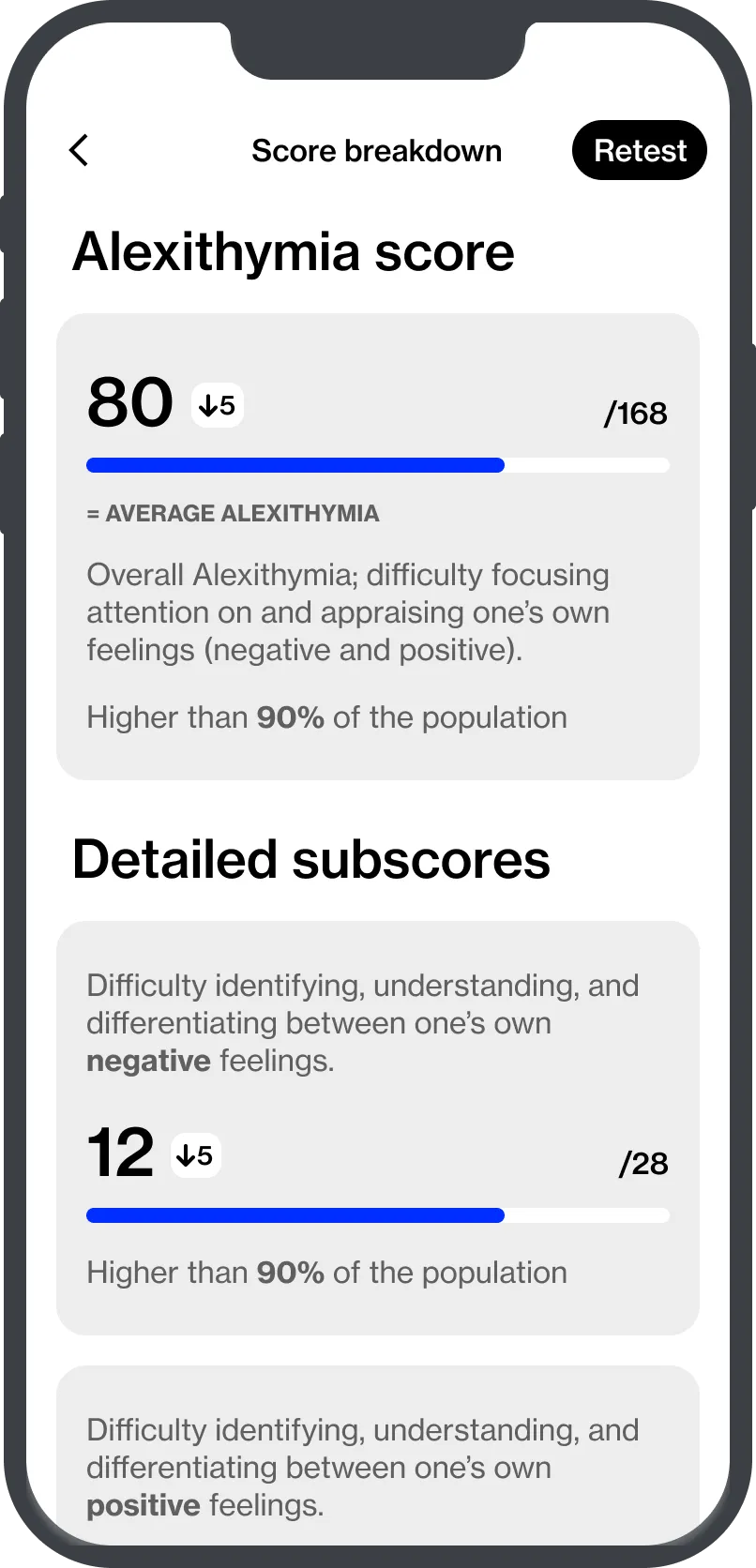
That 2025 study also confirmed that the Perth Alexithymia Questionnaire measures alexithymia fairly in autistic adults, without inflating their scores.[5] It is the questionnaire behind Animi’s free test.
The Empathy Myth
One of the most persistent stereotypes is that autistic people lack empathy. Research on alexithymia has done a lot to take it apart. Psychologists Geoffrey Bird and Richard Cook reviewed the evidence in 2013 and argued that where emotional difficulties show up in autistic people, such as trouble recognizing emotions in faces or weaker empathic responses, they are explained by co-occurring alexithymia rather than by autism.[2] In the studies they reviewed, autistic people without alexithymia often looked no different from non-autistic people on these tasks. So the stereotype may say more about alexithymia than about autism itself.
The picture isn’t fully settled. For recognizing emotion in voices, alexithymia seems to explain part of the difference, not all of it.[2] But the overall direction is clear: struggling to read your own feelings is a specific, measurable difficulty, and it is a different thing from not caring about other people.
Autistic researcher Damian Milton adds a second correction. He calls it the double empathy problem: when autistic and non-autistic people misunderstand each other, the gap runs both ways, and it is “not a singular problem located in” one person.[6] Non-autistic people often misread autistic people just as much. Keeping both ideas in mind helps. Some of what gets labeled an empathy problem is alexithymia, which you can work on, and some is a two-way communication gap, which both sides share.
Is It an Emotion, a Body Signal, or Overload?
When something feels off and you can’t name it, the reflex is to reach for an emotion word. For many autistic adults, it works better to rule out the other possibilities first. A commenter in a discussion for late-diagnosed autistic adults described what careful observation showed them:
“I realized through testing and observation that my outbursts of irritability were sensory overwhelm and now I realize that when it happens, I’m indeed irritable but I’m also itchy everywhere, I feel like everything is so hot, noise is more irritating… And these small-ish bouts of depression were either shutdown/burnout where I can now see that they happen the days after I pushed myself too hard especially after some social events.”[10]
A commenter in r/AutisticAdults, in a discussion for late-diagnosed autistic adults
You can turn that kind of detective work into a routine. When you notice that something is off, work through these questions in order:
- Basics. Am I hungry, thirsty, tired, too hot or cold, or in pain? When did I last eat?
- Input. Is it loud, bright, crowded, or itchy here? Have I been around people or masking for a long time today?
- Body. What is my body doing right now? Describe it plainly: tight jaw, fast heart, heavy chest, restless legs.
- Thoughts. What am I thinking about? Is there worry, dread, a sense of being treated unfairly, or a feeling of being left out?
- Feeling. Only now, try a feeling word, and hold it loosely. “Maybe disappointed?” is a fine answer.
If steps 1 or 2 explain it, look after that first: eat, drink, rest, or reduce the input. Often the “feeling” changes or goes away. If it doesn’t, the remaining signal is more likely an emotion, and the thought check in step 4 is often what separates one from another.
”everything somewhat negative feels like anxiety to me so that feeling just gets labeled as anxiety unless i look at the corresponding thought patterns. am i worried? am i dreading something? am i hungry? am i overstimulated? do i feel rejected?”[11]
A commenter in r/AutismInWomen describing how they sort out what they feel
Over time, you start to see your own patterns: which situations reliably drain you, what your body does before a shutdown, and which thoughts come with which feelings. That pattern library becomes a map of your emotional life, built from your own data.
Practices That Suit How Autistic Minds Work
Standard emotional-awareness advice often starts with “notice how you feel” and a colorful feelings wheel. That can fall flat when feelings don’t arrive with clear labels or clear body sensations. The practices below start from what is easier to observe and build up from there. They draw on research on body awareness and on what autistic adults report working for them. Work within your window of tolerance: as buried signals become clearer, some discomfort is normal and can be a sign of progress. If a practice tips you into panic, detachment, or overwhelm, stop, do something that settles your body, and come back to it more gently later or with support.
Start with what your body is doing
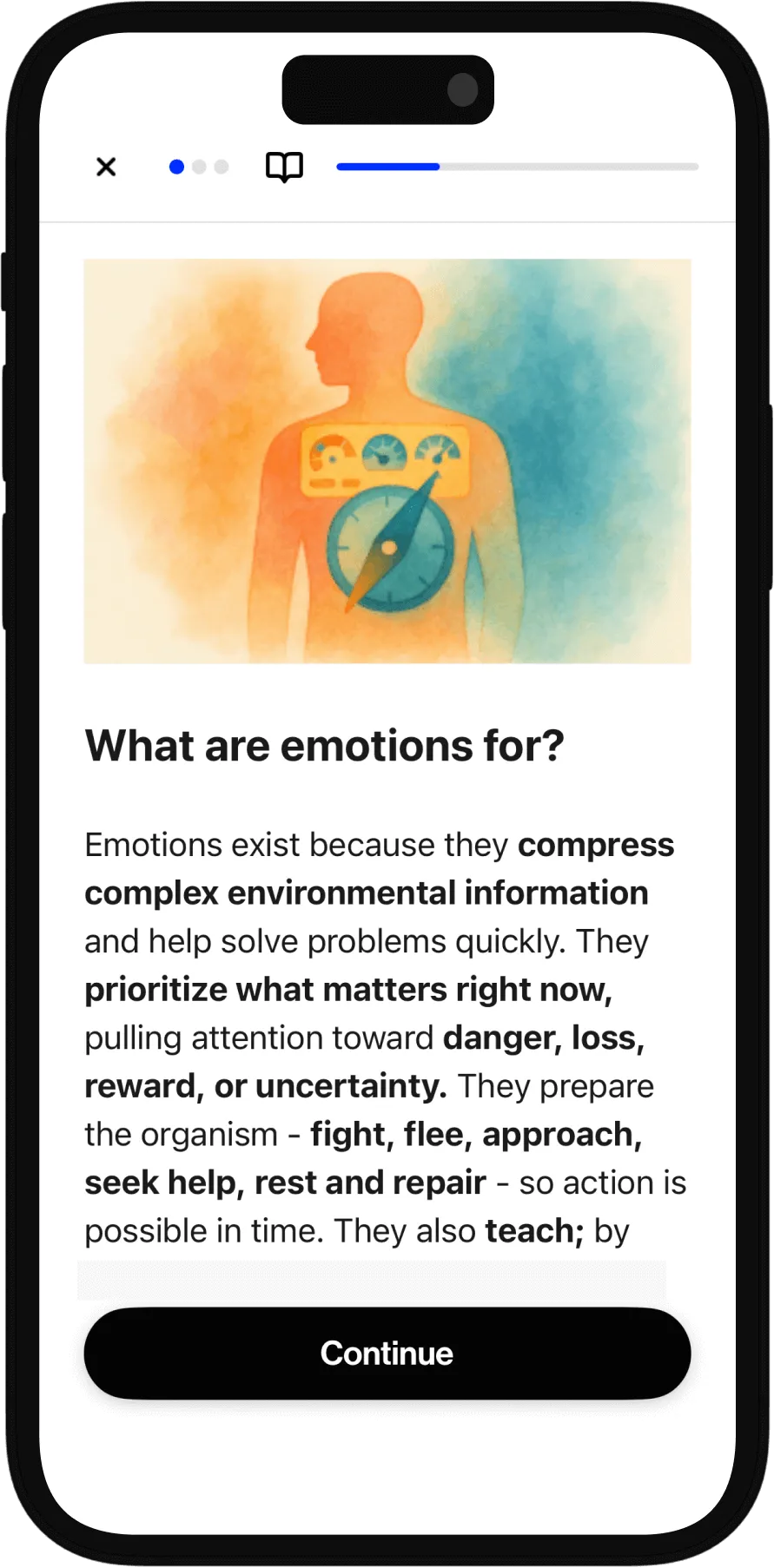
”How do you feel?” can be an impossible question. “What is your body doing?” usually isn’t. Body facts are valid information, and they are often the first step toward a feeling.
Someone asking me: “How do you feel about that?”
A commenter in r/AutisticAdults, in a discussion about doing therapy with alexithymia
Me: “My stomach hurts and I can’t take a full breath.”[12]
That answer already tells you a lot. A few times a day, pause for thirty seconds and describe three body sensations in plain words, from head to feet. Don’t try to interpret them yet. Then, when an answer like “my stomach hurts and I can’t take a full breath” keeps showing up in the same kinds of situations, you have a pattern you can start to name.
Use your own words first
Standard emotion words were mostly built around how non-autistic people describe their inner lives, and they may not match yours. It is fine to start with your own labels: “static-y,” “purple,” “a storm,” “buzzing bones,” or a reference to a character or a song. One commenter suggested exactly this, noting that the words don’t need to be literally meaningful as long as they “feel right” to you.[13] Once your private words are consistent, you can start linking them to standard ones when you need to explain yourself to someone else: “static-y usually means anxious for me.”
Keep a log for feelings that arrive late
Many autistic adults recognize feelings long after the event, sometimes all at once.
”Takes me 2-3 business days to suddenly burst into tears”[14]
A commenter in r/autism
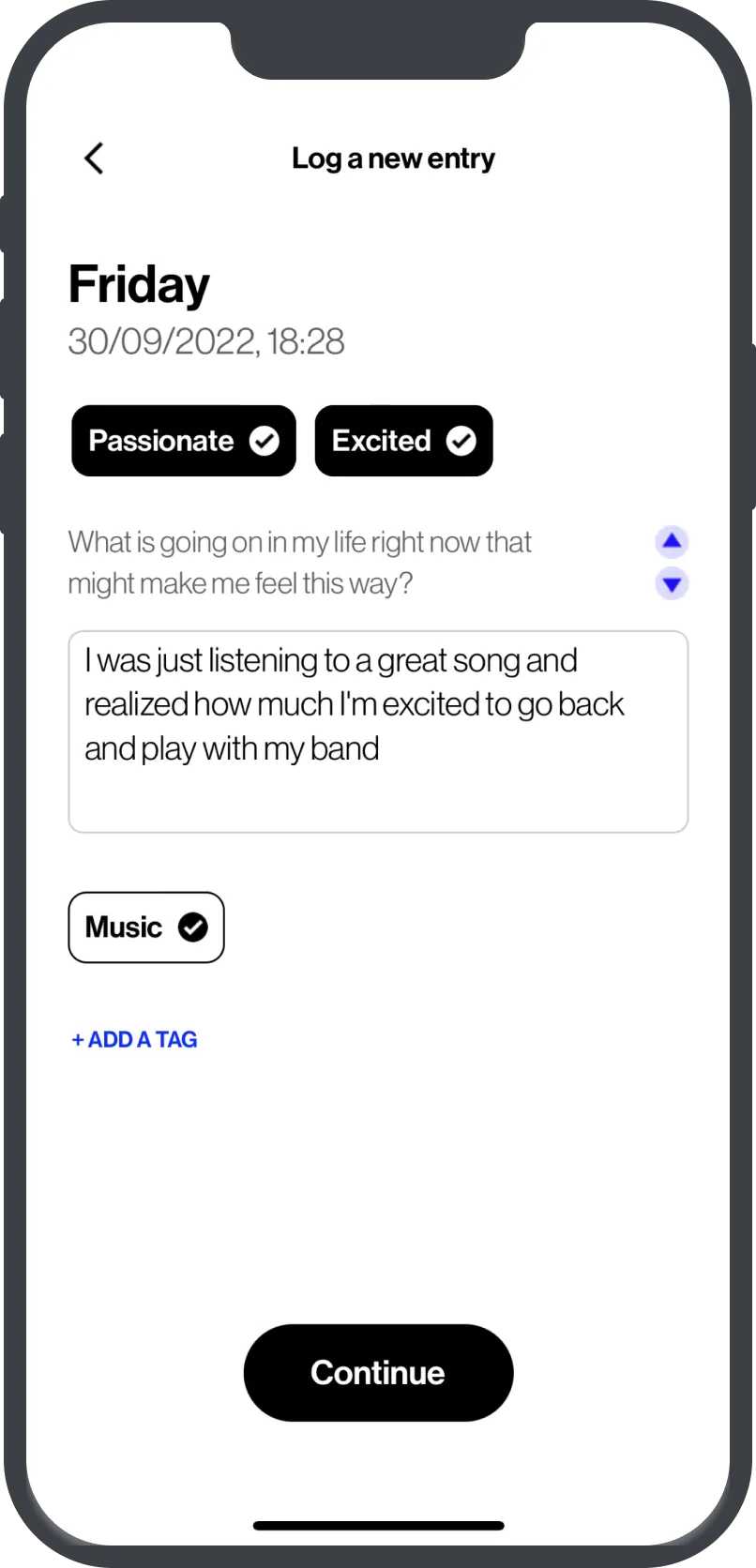
A short log turns those delays into usable data. Each evening, write one line for anything notable: what happened, what your body did, your energy level, and any feeling word that comes to mind, even a rough one. Then, once a week, read back over it. Look for links between events and the body states or moods that followed a day or two later. Pattern-spotting is a strength for many autistic people, and a log gives that strength something to work with. As the patterns become familiar, the gap between event and recognition often shrinks.
Try gentle interoceptive training
Interoceptive training means practicing noticing signals from inside your body. A trial in England tested a version called ADIE with 121 autistic adults. Over six sessions, participants practiced sensing their heartbeat, got feedback on how accurate they were, and repeated the practice after light exercise raised their heart rate. Compared with people who practiced recognizing emotion in voices, they had lower anxiety afterwards. Three months later, 31% of the ADIE group met the trial’s criteria for recovery from anxiety, compared with 16% of the comparison group. The authors note that the training relies very little on language or emotional insight, which makes it more inclusive.[7]
You can try a simple version at home. Sit quietly and try to sense your heartbeat without touching your pulse, for a minute. Then check your pulse at your wrist or neck and compare. Try again after climbing a flight of stairs, when your heart is easier to feel. Over a few weeks, you get better at noticing what your body is doing. Go slowly. One participant in the trial developed anxiety about their heart after the training, so if paying attention to your heartbeat starts to feel alarming, stop and switch to a gentler focus, such as your feet on the floor or your breathing.
Making Therapy and Support Work for You
Self-guided practice can be a sufficient path for many people, but therapy can help too. When alexithymia isn’t recognized, though, therapy can stall. Alexithymia is linked to poorer results from psychotherapy, and the authors of the 2019 review suggest that autistic people with alexithymia may benefit from more targeted support.[1] Many autistic adults know the feelings wheel from therapy, and some found it hard to use.
”The therapist I got would get frustrated and just keep referring me to that colourful feelings wheel and I kept thinking, I already told you I don’t know how to distinguish them, that I don’t feel them in my body. And it’s like they didn’t believe me or were trying to brute force it regardless, so I just started giving out any answer.”[15]
A commenter in r/AutismInWomen, in a discussion about alexithymia and therapy
Alexithymia is worth raising with a clinician for another reason too. In a study of adults referred to an autism clinic, difficulty identifying feelings was the strongest predictor of depressive symptoms, more than autistic traits were, and the same pattern held in people who turned out not to be autistic.[8] A few things can make therapy easier:
- Name it early. Tell your therapist that “I don’t know” is often your honest answer to feeling questions, and bring your test result if you have one.
- Ask for concrete questions. “What did your body do?”, “What happened next?”, or a choice between two options often works better than “How did that make you feel?”
- Bring your log. Written notes from the week give you something to work from that doesn’t depend on recall in the moment.
- Ask for autism adaptations. If you are autistic and starting therapy for anxiety or depression, England’s NICE guidance describes specific adaptations you can ask for. The alexithymia treatment guide summarizes them.
Can You Have Alexithymia Without Autism?
Yes. About 5% of the non-autistic comparison groups in the 2019 review scored in the alexithymia range,[1] and general-population estimates are around one in ten.[2] Alexithymia also appears with depression, trauma, ADHD, and other conditions, and in people with none of them. If you have alexithymia, that alone doesn’t mean you are autistic. The full guide to alexithymia explains where it comes from and how people improve, whatever the cause.
Next Steps
Pick one practice to try this week. If feeling questions make you go blank, start with the five-step check in this guide whenever something feels off. If your feelings tend to arrive late, start a one-line evening log and read it back on the weekend.
- Take the alexithymia test to get a baseline you can revisit.
- Read the full guide to alexithymia for causes, effects, and how people improve.
- See the alexithymia treatment guide for therapy options and what to ask for.
- Work through the Emotions 101 course to build body awareness and emotion vocabulary at your own pace.
References
Show referencesHide references
- Kinnaird E, Stewart C, Tchanturia K. Investigating alexithymia in autism: a systematic review and meta-analysis. Eur Psychiatry. 2019;55:80-89. doi:10.1016/j.eurpsy.2018.09.004.
- Bird G, Cook R. Mixed emotions: the contribution of alexithymia to the emotional symptoms of autism. Transl Psychiatry. 2013;3(7):e285. doi:10.1038/tp.2013.61.
- Nicholson TM, Williams DM, et al. Interoceptive impairments do not lie at the heart of autism or alexithymia. J Abnorm Psychol. 2018;127(6):612-622. doi:10.1037/abn0000370.
- Yorke I, Murphy J, Rijsdijk F, et al. Alexithymia may explain the genetic relationship between autism and sensory sensitivity. Transl Psychiatry. 2025;15:75. doi:10.1038/s41398-025-03254-1.
- Brett JD, Jarvers I, Uljarevic M, Whitehouse A, Gross JJ, Samson AC, Preece DA. Characterizing the nature of alexithymia in autistic adults: validation of the Perth Alexithymia Questionnaire. Autism Adulthood. 2025. doi:10.1177/25739581251371420.
- Milton DEM. On the ontological status of autism: the ‘double empathy problem’. Disabil Soc. 2012;27(6):883-887. doi:10.1080/09687599.2012.710008.
- Quadt L, et al. Interoceptive training to target anxiety in autistic adults (ADIE): a single-center, superiority randomized controlled trial. EClinicalMedicine. 2021;39.
- Bloch C, Burghof L, Lehnhardt FG, et al. Alexithymia traits outweigh autism traits in the explanation of depression in adults with autism. Sci Rep. 2021;11:2258. doi:10.1038/s41598-021-81696-5.
- Reddit, r/AutisticAdults. Comment in the discussion “Alexithymia and ASD. Can’t understand physical and emotional sensations unless extreme?”. Individual experience, June 2026.
- Reddit, r/AutisticAdults. Comment in the discussion “Late diagnosed people - Do you also have alexithymia?”. Individual experience, October 2024.
- Reddit, r/AutismInWomen. Comment in the discussion “So…how exactly am I supposed to recognize my emotions?”. Individual experience, April 2026.
- Reddit, r/AutisticAdults. Comment in the discussion “How am I supposed to do well in therapy if I’m alexithymic?”. Individual experience, April 2024.
- Reddit, r/AutismInWomen. Comment in the discussion “So…how exactly am I supposed to recognize my emotions?”. Individual experience, April 2026.
- Reddit, r/autism. Comment in the discussion “People who are autistic, how many of you relate to this comment I saw on here?”. Individual experience, June 2024.
- Reddit, r/AutismInWomen. Comment in the discussion “Alexithymia is SO MUCH MORE than not understanding your emotions”. Individual experience, November 2024.